Find and Fix Accessibility Barriers Across Your Digital Product

Assess websites and web applications against WCAG 2.2 using automated checks, manual testing, keyboard review and assistive-technology workflows, then turn findings into actionable remediation guidance.
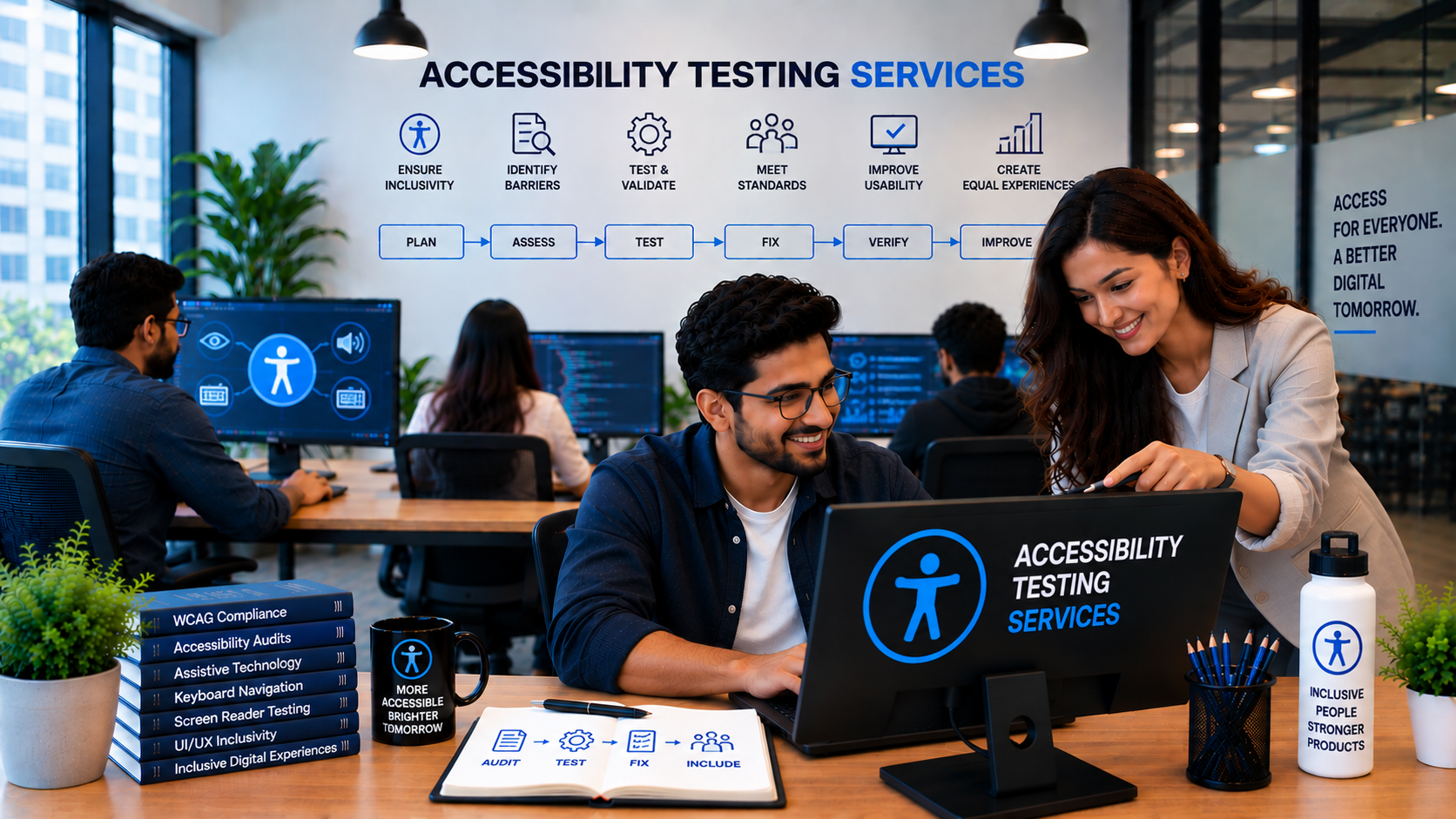
Move Beyond Automated Accessibility Scores
Automation finds useful issues; human testing is required to understand many real barriers.
WCAG success criteria are technology-independent and conformance testing requires more than a scanner. We combine automated tooling with manual inspection of keyboard behavior, semantics, focus, forms, responsive interactions and assistive-technology behavior so teams receive findings they can reproduce and fix.
Three benefits.
WCAG 2.2 Focus
Manual + Automated Testing
Developer-Ready Remediation
Accessibility Services We Deliver
Website Accessibility Audits
Structured WCAG review for public websites and content experiences.
Web App Accessibility Testing
Test dashboards, forms, dialogs and dynamic product workflows.
Screen Reader Testing
Review key journeys with appropriate assistive-technology workflows.
Keyboard & Focus Testing
Validate keyboard access, focus order, visibility and interaction.
Accessibility Remediation
Support design and engineering teams in correcting verified issues.
Accessibility Regression Testing
Re-test remediated flows and protect key accessible behaviors over time.






WCAG 2.2 Manual Testing
Test the experience people use, not only the DOM that a scanner sees.
Manual testing evaluates behaviors that automated rules cannot fully determine, including meaningful focus order, keyboard operability, accessible names in context, error handling and complex component interaction. Findings should include enough evidence for designers and developers to reproduce the barrier and verify the fix.
Architecture
Integration
Quality
Security
Observability
Evolution
Core Accessibility Testing Capabilities
Capability
WCAG 2.2
Supporting copy
Assess applicable interfaces against current accessibility success criteria.
Capability
Keyboard Testing
Supporting copy
Verify essential workflows without requiring a pointing device.
Capability
Focus Management
Supporting copy
Check that focus order and visibility support clear navigation.
Capability
Screen Readers
Supporting copy
Test important journeys using appropriate assistive technologies.
Capability
Semantic HTML
Supporting copy
Confirm that structure and meaning are represented correctly.
Capability
ARIA Review
Supporting copy
Validate ARIA usage without replacing native semantic controls.
Capability
Forms & Errors
Supporting copy
Check labels, instructions, validation and error recovery.
Capability
Color & Contrast
Supporting copy
Evaluate text, controls and states for sufficient distinction.
Capability
Responsive/Mobile
Supporting copy
Test accessibility across screen sizes and touch interactions.
Capability
Automated Scanning
Supporting copy
Identify repeatable rule violations using automated tools.
Capability
Remediation
Supporting copy
Translate findings into practical design, content and code corrections.
Capability
Regression Testing
Supporting copy
Protect accessibility improvements throughout future releases.
How We Deliver
Discover
Understand users, architecture, risks and delivery requirements.
Architect
Define boundaries, contracts, security and implementation approach.
Build / Assess
Implement or test the prioritized capabilities in controlled increments.
Integrate
Connect data, systems, tooling and delivery workflows.
Validate
Test functional, quality, performance and security expectations appropriate to scope.
Release & Improve
Deploy or hand over findings, observe results and iterate.
Ready to Plan the Next Step?
Accessibility Testing & WCAG Technology Stack
5.0 REVIEWS
The stack below provides service-specific content for the existing component. It should not imply that every engagement uses every technology or that Virtual Coders holds unverified vendor certifications.
Standards
Automation
Browsers
Assistive Technology
Frontend
Design
Testing
Reporting
WCAG 2.2 Manual Testing
Discovery
Understand context before selecting implementation or test strategy.
Architecture
Keep responsibilities and boundaries explicit.
Automation
Automate repeatable work where the signal is reliable.
Human Review
Keep judgment where context matters.
Evidence
Make outcomes reproducible and understandable.
Continuous Improvement
Use feedback to improve product and process.
Integrations & Ecosystem
Source Control
GitHub | GitLab | Azure DevOps
Cloud
AWS | Azure | Google Cloud
Identity
OAuth/OIDC | SSO | enterprise identity
Data
SQL | NoSQL | APIs
Business Systems
ERP | CRM | third-party SaaS
Delivery / QA
CI/CD | testing | observability tooling
Engagement Model
Accessible and Responsible Product Delivery
Apply controls according to the service, application risk and client environment.
Identity & Access
Use least privilege and role-aware access.
Data Protection
Protect sensitive data according to application requirements.
Secrets
Keep credentials outside source code.
Validation
Validate application and integration boundaries.
Auditability
Retain useful evidence for important actions or test findings.
Recovery / Remediation
Define rollback, remediation or escalation paths.
Security and governance should be explicit but evidence-based. Avoid unsupported compliance, accessibility or security guarantees; define the target standard, test scope or engineering responsibility clearly.
Why Choose Virtual Coders for Accessibility Testing & WCAG?

"Game-Changing Custom SaaS Solutions – Highly Recommended! Working with Virtual Coders to develop our custom SaaS platform was transformative. Their team grasped our unique needs and delivered a robust solution, greatly enhancing our operations. Their attention to detail and proactive communication made the process smooth and enjoyable. Highly recommended for Australian companies seeking to enhance their software solutions!"

Rick Giesel
Owner, ICT
Why Choose Virtual Coders for Accessibility Testing & WCAG?
✓Cross-functional engineering and QA capability.
✓Frontend, backend, cloud, API and integration experience.
✓Modern delivery practices with explicit quality controls.
✓Ability to support implementation as well as assessment/remediation where relevant.
✓No unsupported certification, conformance or performance claims.
Frequently Asked Questions



Need a WCAG 2.2 Accessibility Review?
We begin with the product, current architecture or quality objective, then define scope, responsibilities, evidence and acceptance criteria.
Yes. We can work within existing repositories, architecture and delivery processes rather than requiring a rebuild.
Yes, where appropriate. We can separate assessment findings from remediation scope so responsibilities and verification remain clear.
Project access follows least privilege and the client's policies for repositories, environments, credentials and production systems.
Yes. AWS, Azure and Google Cloud delivery can be included when relevant.
Yes. We generally work with the client's existing repositories, CI/CD, testing, cloud and collaboration tooling when practical.
We define acceptance criteria and use suitable code review, automated testing, manual QA or specialist testing according to the service.
Yes. Ongoing engineering, QA, remediation or optimization can be structured through sprint-based or time-and-material engagements.
SEND US A MESSAGE.

READY TO ACCELERATE YOUR TECH JOURNEY?
Partner with our expert engineers to transform your ideas into scalable, high-performance solutions tailored to your business needs.

OUR OFFICES
India
E-414 to 416, Ganesh Glory 11, Jagatpur Road, Nr. BSNL Office, off. S.G. Highway, Jagatpur, Ahmedabad, Gujarat - 382470
Australia
18, Giancarlo Crescent, Doolandella-4077, QLD, Australia
Canada
20 Meadowglen Pl, Toronto, ON M1H 2Y5