Build AI Agents That Go Beyond Answers to Take Action

Design AI agents that understand context, use business knowledge, interact with approved tools and APIs, and execute controlled multi-step workflows.
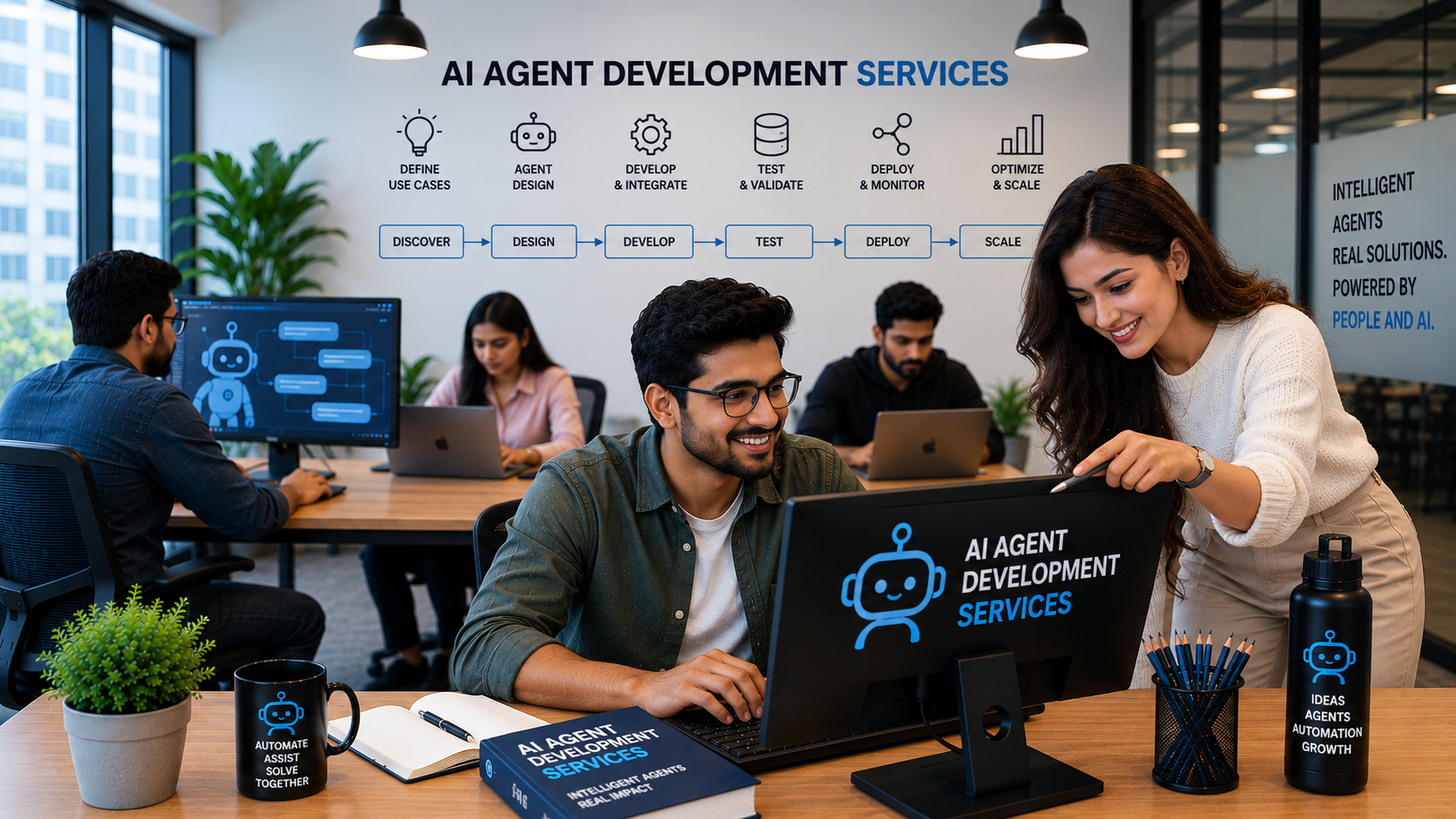
Move From AI That Answers to AI That Executes
Build agentic systems around real workflows, permissions and measurable outcomes.
We design the agent around the work it must complete: the context it needs, the tools it may use, the decisions it can make and the points where a person should remain in control. This keeps agentic behavior connected to a real operational outcome instead of becoming an isolated AI demonstration.
Three benefits.
Goal-Oriented Engineering
Controlled Tool Access
Observable by Design
AI Agents for Real Business Workflows
Enterprise AI Agents
Agents connected to internal knowledge, tools and enterprise workflows.
Workflow Agents
Coordinate multi-step operational tasks across systems.
Customer Service Agents
Assist or execute approved support processes.
Data & Analytics Agents
Retrieve, analyze and summarize governed business data.
AI Copilot Agents
Assist users while keeping decisions and actions under human control.
Multi-Agent Systems
Coordinate specialized agents when decomposition creates clear value.






Agentic Workflow Automation
Give agents the tools to act without giving them unlimited control.
Agentic automation combines model reasoning with application state, business rules and controlled tool access. The agent can interpret context and plan dynamic steps, while deterministic controls and human approvals protect predictable or sensitive parts of the workflow.
Context Interpretation
Multi-Step Planning
Tool & API Use
Business Rules
Human Approval
Execution History
Core AI Agent Capabilities
Capability
Reasoning & Planning
Supporting copy
Plan steps toward a defined goal
Capability
Tool & API Calling
Supporting copy
Interact with approved systems
Capability
Enterprise Knowledge / RAG
Supporting copy
Retrieve relevant business context
Capability
Memory
Supporting copy
Maintain useful task/session state
Capability
Human-in-the-Loop
Supporting copy
Request review or approval
Capability
Permissions
Supporting copy
Constrain accessible data and actions
Capability
Multi-Agent Orchestration
Supporting copy
Coordinate specialized agent roles
Capability
Structured Outputs
Supporting copy
Return machine-usable responses
Capability
Workflow State
Supporting copy
Track progress across steps
Capability
Evaluation
Supporting copy
Measure task and behavior quality
Capability
Tracing
Supporting copy
Inspect model/tool execution
Capability
Fallbacks
Supporting copy
Recover, retry or escalate
How We Build AI Agents
Discover
Define business goal, users, systems, risk and measurable completion.
Design
Choose agent architecture, tools, state, RAG, permissions and human checkpoints.
Build & Integrate
Engineer the agent and connect approved enterprise systems.
Evaluate
Test task success, tool behavior, edge cases and failure recovery.
Deploy
Release with observability, security and controlled permissions.
Improve
Use production traces and evaluations to improve behavior.
Build an AI Agent Around a Real Workflow
AI Agent Technology Stack
5.0 REVIEWS
The technology stack should support the complete agent lifecycle, from model access and orchestration to enterprise knowledge, tool integration, application UX and production tracing. We keep provider choice flexible so architecture is driven by the workflow rather than a single model vendor.
Models
Orchestration
RAG / Search
Backend
Apps
Cloud & Ops
Reason, Retrieve, Use Tools and Act Under Control
Planning
Determine the next step according to the goal and current state.
Knowledge
Retrieve relevant enterprise context through RAG or APIs.
Tools
Call only approved functions and business systems.
State
Maintain workflow/session context.
Human Control
Require confirmation for sensitive or ambiguous actions.
Evaluation & Tracing
Measure outcomes and investigate behavior.
Connect With the Systems Your Business Already Uses
CRM
Salesforce | HubSpot | custom CRM APIs
ERP
SAP | Odoo | ERPNext | Dynamics 365
Communication
Email | Slack/Teams-style channels | SMS/WhatsApp APIs
Data
Databases | warehouses | search | RAG sources
Business APIs
Internal REST APIs | webhooks | third-party SaaS
Identity
SSO | OAuth | role/permission services
Engagement Model
Build Agents With Control, Not Unchecked Autonomy
Use layered controls according to the action and business risk.
Tool Permissions
Expose only approved actions.
Data Boundaries
Apply user, role and tenant access.
Human Approval
Require confirmation where judgment is needed.
Validation
Validate structured outputs and tool inputs.
Auditability
Trace important actions and state changes.
Fallback & Escalation
Stop, retry or hand work to a human.
Design agent permissions, data access, validation and approval boundaries around what the agent is allowed to do. Sensitive or high-impact actions can require human confirmation, while fallbacks and audit trails help keep execution controlled and traceable.
Why Choose Virtual Coders for AI Agent Development?

"Game-Changing Custom SaaS Solutions – Highly Recommended! Working with Virtual Coders to develop our custom SaaS platform was transformative. Their team grasped our unique needs and delivered a robust solution, greatly enhancing our operations. Their attention to detail and proactive communication made the process smooth and enjoyable. Highly recommended for Australian companies seeking to enhance their software solutions!"

Rick Giesel
Owner, ICT
Why Choose Virtual Coders for AI Agents?
✓Workflow-first discovery before autonomy.
✓Full-stack integration with applications, APIs and enterprise systems.
✓RAG and data engineering for grounded context.
✓Human-controlled actions and permission-aware design.
✓Evaluation and observability for production improvement.
Frequently Asked Questions



Have Questions About Building AI Agents?
An AI agent is a software system that can interpret a goal, use context, choose steps and interact with approved tools or APIs to complete part of a workflow.
A chatbot primarily exchanges messages. An agent can maintain state, choose actions and use tools to progress toward a defined goal.
Yes. Agents can interact with approved APIs, databases, CRM, ERP and other systems according to available interfaces and permissions.
Not always. RAG is useful when the agent needs enterprise knowledge or current information that should be retrieved at runtime.
It can take approved actions, but autonomy should match the risk. Sensitive actions can require deterministic validation or human approval.
Evaluation can measure task completion, tool selection, permissions, trajectory, state changes, recovery and final outcomes.
Yes, where multiple specialized roles genuinely improve the workflow. We do not recommend multi-agent complexity when one controlled agent is sufficient.
Architecture can support leading providers such as OpenAI, Claude, Gemini, Azure OpenAI and Amazon Bedrock based on the use case.
SEND US A MESSAGE.

READY TO ACCELERATE YOUR TECH JOURNEY?
Partner with our expert engineers to transform your ideas into scalable, high-performance solutions tailored to your business needs.

OUR OFFICES
India
E-414 to 416, Ganesh Glory 11, Jagatpur Road, Nr. BSNL Office, off. S.G. Highway, Jagatpur, Ahmedabad, Gujarat - 382470
Australia
18, Giancarlo Crescent, Doolandella-4077, QLD, Australia
Canada
20 Meadowglen Pl, Toronto, ON M1H 2Y5