Measure AI Quality. Test Failure Modes. Build Better Controls.

Design evaluation frameworks, guardrails and observability for LLM applications, RAG systems, copilots and AI agents so production behavior can be measured and improved with evidence.
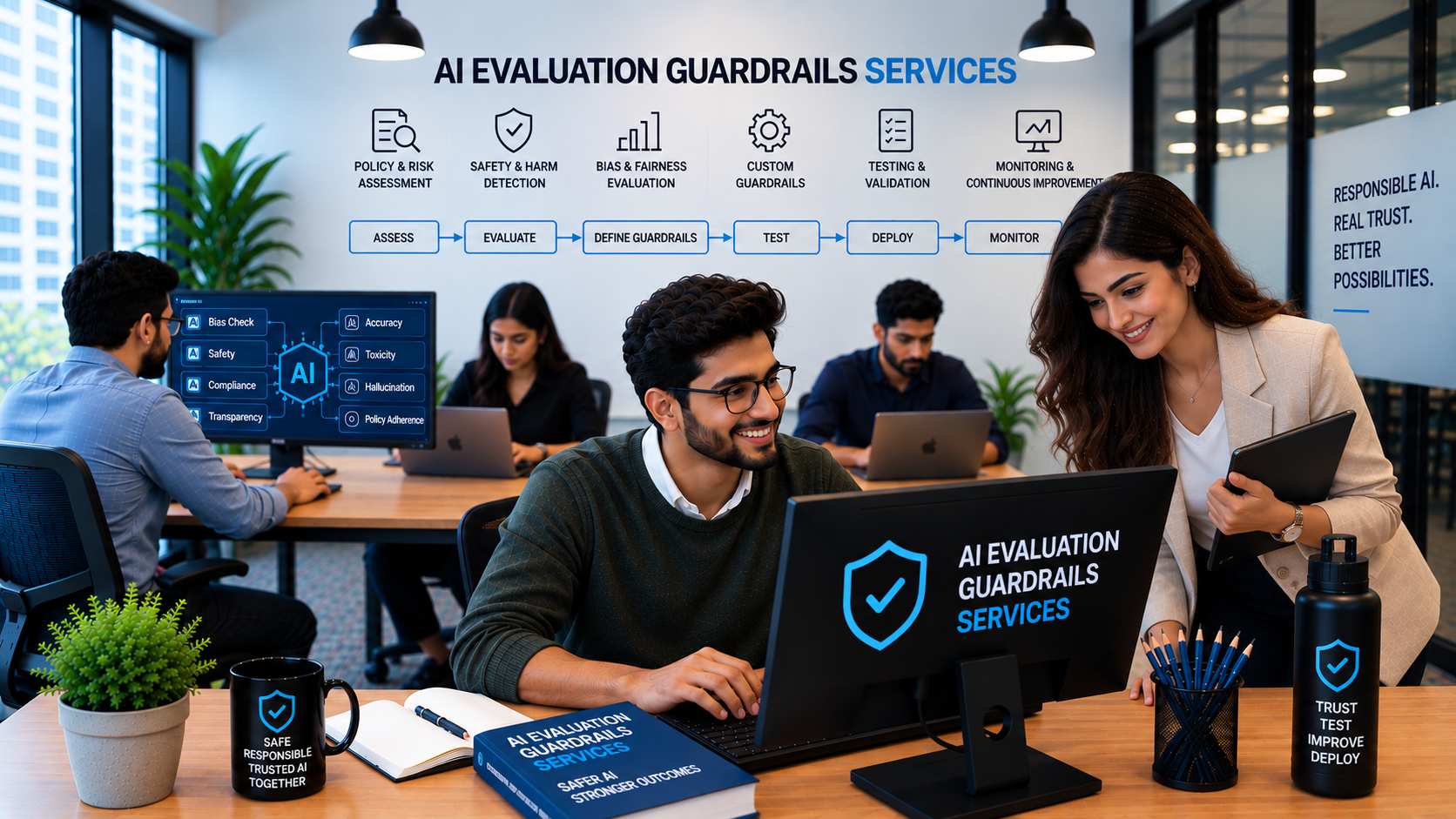
Production AI Needs More Than a Successful Demo
Measure the complete AI system across realistic tasks, edge cases, tools, data and production behavior.
AI quality should be defined against the tasks users actually perform, not only generic model benchmarks. We turn product expectations and risk scenarios into repeatable evaluations that cover the model, retrieval, tools, application logic and human-control boundaries.
Three benefits.
Measurable Quality
Practical Guardrails
Production Observability
Evaluation Across the AI Application Stack
LLM Applications
Instruction following, structured outputs, relevance and application-specific quality.
RAG Systems
Retrieval relevance, groundedness, source correctness and access-aware retrieval.
AI Copilots
Usefulness, context awareness, knowledge grounding and human-control boundaries.
AI Agents
Task completion, trajectories, tool selection, permissions and recovery.
AI Workflows
End-to-end completion, AI decisions, rules, approvals and exceptions.
Multi-Model Systems
Compare application behavior across models/providers using equivalent tasks.






Build Evals Around the Workflow, Not Just the Model
Evaluate the complete system in realistic conditions.
Evaluation becomes more useful when it is tied to representative workflows and explicit acceptance criteria. By testing the full system, including data, tools, multi-turn state and failure cases, teams can identify whether a problem comes from the model, retrieval, orchestration or application layer.
Representative Tasks
Realistic Tools & Data
Multi-Turn Scenarios
Expected Outcomes
Automated Graders
Human Review
Core Evaluation Dimensions
Capability
Task Success
Supporting copy
Did the workflow complete correctly?
Capability
Relevance
Supporting copy
Is the output useful to the task?
Capability
Groundedness
Supporting copy
Is the answer supported by available evidence?
Capability
Factuality
Supporting copy
Are expected facts correct?
Capability
Retrieval Quality
Supporting copy
Did RAG retrieve useful context?
Capability
Structured Output
Supporting copy
Does output match required schema?
Capability
Tool Selection
Supporting copy
Were appropriate tools used?
Capability
Permission Compliance
Supporting copy
Were boundaries respected?
Capability
Safety Behavior
Supporting copy
Did controls respond as intended?
Capability
Latency
Supporting copy
Is response time acceptable?
Capability
Cost / Token Usage
Supporting copy
Is usage observable and sustainable?
Capability
Regression Stability
Supporting copy
Did a change degrade known behavior?
How We Build AI Evaluation
Define Success
Translate product requirements and risks into measurable criteria.
Build Dataset
Create representative, edge-case and adversarial cases.
Design Graders
Combine deterministic checks, references, model graders and human review.
Run & Analyze
Execute the full AI system and inspect failures.
Improve & Guard
Adjust prompts, retrieval, tools, permissions and controls.
Regression & Monitor
Run repeatable tests and turn production failures into new evals.
Improve AI With Evidence
AI Evaluation Technology
5.0 REVIEWS
Evaluation and guardrails sit across the AI application stack, so the tooling may include test harnesses, model/provider evaluation features, tracing, conventional automated testing and production telemetry. We choose the combination according to the system and the evidence the team needs.
Evaluation
Observability
Testing
AI Platforms
RAG
Deployment
Measure What AI Does and Constrain What It Can Do
Input Controls
Validate or filter incoming requests.
Output Controls
Validate schemas, policies and response boundaries.
Tool Permissions
Limit actions and systems.
Human Approval
Require people for sensitive decisions.
Tracing
Capture model, retrieval and tool behavior.
Monitoring
Detect failures and behavioral changes in production.
Connect With the Systems Your Business Already Uses
AI Apps
LLM apps | RAG | copilots | agents | workflows
Data
Knowledge sources | vector/search | databases
CI/CD
Evaluation gates | regression suites
Observability
Langfuse | telemetry | application monitoring
Identity
RBAC | tenant/user context
Ticketing / Ops
Integrate failure workflows with existing engineering operations where required
Engagement Model
Add Controls Around What AI Can See, Say and Do
Guardrails reduce specific risks; they do not guarantee complete safety.
Input Validation
Check requests and context.
Output Validation
Validate schemas and defined policies.
Data Boundaries
Apply user/tenant/source permissions.
Tool Permissions
Constrain available actions.
Human Approval
Insert judgment where required.
Fallback & Escalation
Stop or route uncertain cases.
Guardrails should address specific risks rather than promise universal AI safety. We layer validation, permissions, data boundaries, action controls, human review and fallback behavior according to what the application is allowed to see, say and do.
Why Choose Virtual Coders for AI Evaluation?

"Game-Changing Custom SaaS Solutions – Highly Recommended! Working with Virtual Coders to develop our custom SaaS platform was transformative. Their team grasped our unique needs and delivered a robust solution, greatly enhancing our operations. Their attention to detail and proactive communication made the process smooth and enjoyable. Highly recommended for Australian companies seeking to enhance their software solutions!"

Rick Giesel
Owner, ICT
Why Choose Virtual Coders for AI Evaluation & Guardrails?
✓AI + conventional software QA.
✓Full-stack understanding of RAG, tools and application state.
✓Production traces and observability.
✓Workflow-specific evaluations instead of generic benchmark-only claims.
✓Evidence-driven improvement of prompts, retrieval, tools and guardrails.
Frequently Asked Questions



Can You Measure Your AI Before Users Depend on It?
They define and test whether an AI system meets expected product requirements across criteria such as task success, relevance, groundedness, tool behavior, safety boundaries, latency and cost.
LLM evaluation tests model-powered behavior against explicit criteria and representative cases, ideally including the surrounding prompts, data, tools and application logic.
Guardrails are controls around inputs, outputs, data access and actions, such as validation, permissions, approval, fallbacks and audit logging.
It can test unsupported or incorrect claims using evidence, references, graders and human review, but it cannot guarantee an AI system will never be wrong.
Retrieval and generation should be measured separately using relevance, groundedness, source correctness and permission-boundary tests.
Agent evaluation focuses on task outcomes, trajectories, tools, permissions, state changes and recovery behavior.
It captures traces and operational signals from model calls, retrieval, tools and guardrails so teams can investigate production behavior.
Yes. Repeatable datasets and graders can be run when prompts, models, retrieval or application logic change, with human review where needed.
SEND US A MESSAGE.

READY TO ACCELERATE YOUR TECH JOURNEY?
Partner with our expert engineers to transform your ideas into scalable, high-performance solutions tailored to your business needs.

OUR OFFICES
India
E-414 to 416, Ganesh Glory 11, Jagatpur Road, Nr. BSNL Office, off. S.G. Highway, Jagatpur, Ahmedabad, Gujarat - 382470
Australia
18, Giancarlo Crescent, Doolandella-4077, QLD, Australia
Canada
20 Meadowglen Pl, Toronto, ON M1H 2Y5