Build the Data Foundation Your AI Products Can Actually Use

Connect structured and unstructured enterprise data through reusable ingestion, metadata, quality, retrieval and governance layers for RAG, copilots, agents and AI-powered applications.
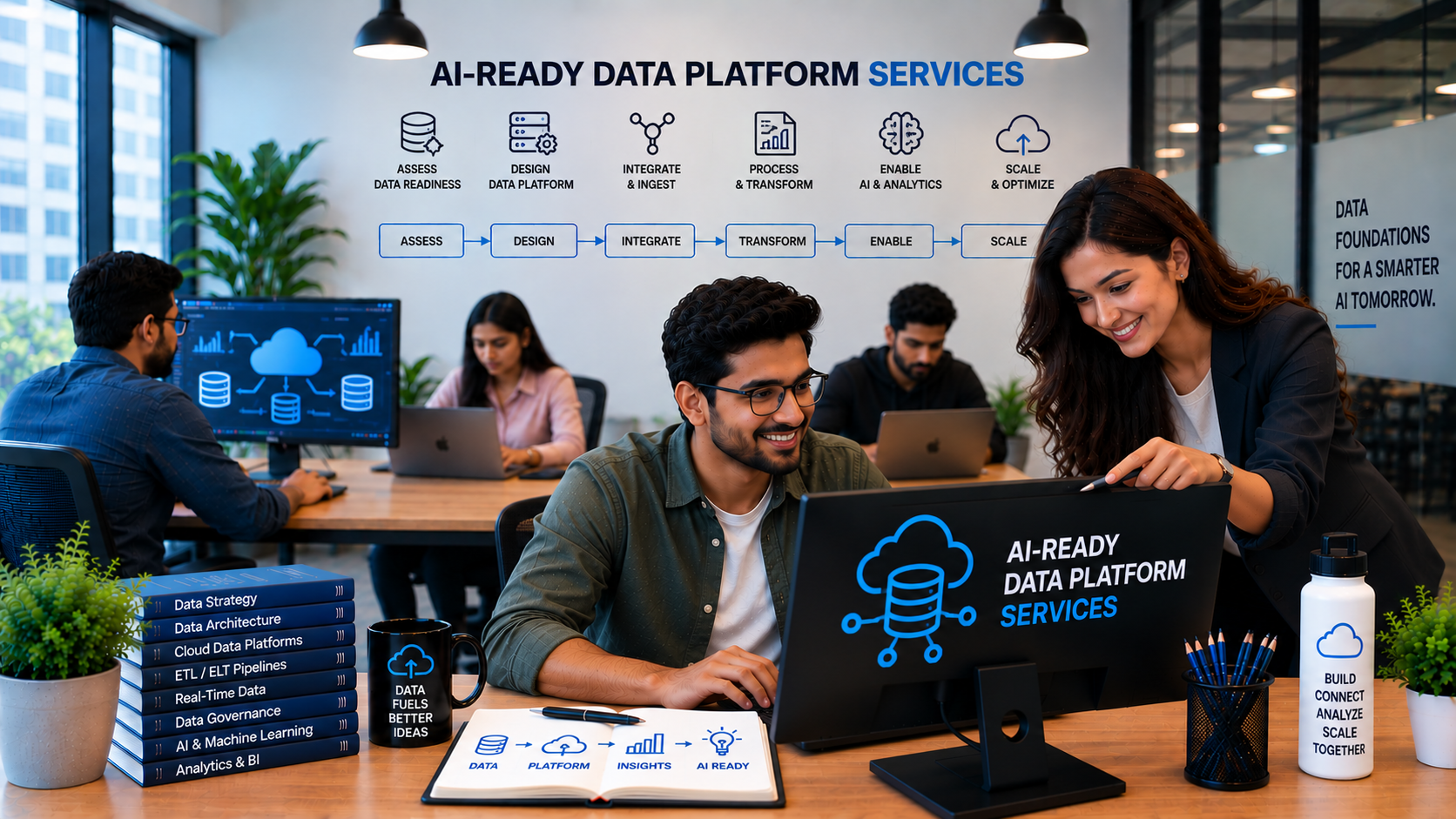
AI Scales Only When the Data Foundation Scales With It
Stop every AI pilot from rebuilding its own ingestion, metadata, embedding and access layer.
AI-ready data is not created by embedding every document into a vector store. We connect structured records, unstructured content, metadata, lineage, permissions and reusable retrieval services so multiple AI applications can work from a consistent enterprise foundation.
Three benefits.
Structured + Unstructured
Reusable AI Data Services
Governed by Design
Reusable Data Foundations for Enterprise AI
AI Knowledge Platforms
Prepare enterprise content for governed AI retrieval.
Structured + Unstructured Foundations
Link business records with documents and derived artifacts.
Enterprise Retrieval Layers
Shared vector, keyword, metadata and hybrid retrieval.
AI Data Products
Curated datasets/content products for AI domains.
Agent Data Access Layers
Controlled retrieval and data services for agents.
AI Data Modernization
Modernize fragmented legacy data/content flows for AI.






Structured + Unstructured Data as One AI Foundation
Preserve the business relationships AI needs to understand context.
Enterprise AI often needs to connect a document with the customer, product, transaction or policy it belongs to. We preserve those relationships through metadata, entity linking and source lineage so downstream retrieval has business context rather than isolated text fragments.
Business Entities
Enterprise Content
Metadata
Entity Linking
Derived Artifacts
Source / Version
Core AI Data Capabilities
Capability
Data Ingestion
Supporting copy
Connect approved sources
Capability
Document Processing
Supporting copy
Extract usable content
Capability
Metadata Enrichment
Supporting copy
Add business context
Capability
Entity Linking
Supporting copy
Connect content and records
Capability
Data Quality
Supporting copy
Validate source and derived artifacts
Capability
Artifact Lineage
Supporting copy
Trace transformations
Capability
Embedding Pipelines
Supporting copy
Generate/version embeddings
Capability
Vector Search
Supporting copy
Semantic retrieval
Capability
Hybrid Retrieval
Supporting copy
Combine semantic and lexical signals
Capability
Access-Aware Retrieval
Supporting copy
Apply permissions at runtime
Capability
Refresh / Versioning
Supporting copy
Keep content current
Capability
AI Data APIs
Supporting copy
Serve reusable data/context
How We Build AI-Ready Data Platforms
Prioritize Use Cases
Identify which RAG, copilot, agent or analytical applications matter.
Assess Readiness
Map sources, quality, metadata, ownership, access and refresh.
Design Foundation
Define data/content products, storage, indexing, retrieval and governance.
Build Shared Services
Implement reusable extraction, enrichment, embedding and retrieval.
Validate With AI
Test retrieval quality, permissions and source traceability.
Operate & Evolve
Refresh content and onboard new AI use cases without rebuilding the foundation.
Create a Reusable Foundation for Enterprise AI
AI Data Platform Technology
5.0 REVIEWS
An AI-ready data platform combines conventional data engineering with content processing, search, vector retrieval, AI services and cloud infrastructure. We choose technologies according to the enterprise sources, retrieval patterns, governance requirements and AI applications the foundation must support.
Data Engineering
Structured Data
Vector / Search
AI / RAG
Cloud
Infrastructure & Ops
Use Vector Search as One Part of the Retrieval Strategy
Vector Search
Semantic similarity across embeddings.
Keyword Search
Exact terms, names and precise terminology.
Metadata Filtering
Narrow results by business attributes.
Hybrid Retrieval
Combine lexical and semantic signals.
Structured Query / API
Retrieve deterministic business records.
Access-Aware Retrieval
Apply user, role and tenant permissions.
Connect With the Systems Your Business Already Uses
Structured Data
Databases | ERP | CRM | operational APIs
Unstructured Content
Documents | files | transcripts | repositories
Search
Vector | keyword | hybrid search
AI Consumers
RAG | copilots | agents | AI search
Identity
SSO | RBAC | tenant/user context
Cloud
Object storage | managed data/search services | APIs
Engagement Model
Carry Data Permissions Into the Retrieval Layer
Source permissions must survive extraction, chunking, indexing and runtime retrieval.
Identity Context
Apply current user/role.
Tenant Boundaries
Separate organization access.
Content Permissions
Respect source-level restrictions.
Metadata Filtering
Enforce policy during retrieval.
Traceability
Keep source and version lineage.
Auditability
Trace processing and access where appropriate.
Permissions need to survive every transformation from source data through extracted content, chunks, embeddings and indexes. We propagate identity, tenant and content policy into runtime retrieval so derived AI artifacts do not accidentally bypass the access rules of the authoritative source.
Why Choose Virtual Coders for AI-Ready Data Platforms?

"Game-Changing Custom SaaS Solutions – Highly Recommended! Working with Virtual Coders to develop our custom SaaS platform was transformative. Their team grasped our unique needs and delivered a robust solution, greatly enhancing our operations. Their attention to detail and proactive communication made the process smooth and enjoyable. Highly recommended for Australian companies seeking to enhance their software solutions!"

Rick Giesel
Owner, ICT
Why Choose Virtual Coders for AI-Ready Data?
✓Structured and unstructured data engineering.
✓RAG and retrieval architecture expertise.
✓API and enterprise-system integration.
✓Cloud/platform engineering for reusable services.
✓Evaluation and observability around retrieval and AI consumption.
Frequently Asked Questions



Is Your Data Foundation Ready for Enterprise AI?
They design reusable data foundations for AI applications, combining structured/unstructured ingestion, metadata, quality, lineage, retrieval, access controls and APIs.
It is data that is sufficiently accessible, current, contextualized, traceable and permission-aware for a defined AI use case.
It extends conventional data disciplines to unstructured content and derived AI artifacts such as chunks, embeddings and retrieval indexes.
Not always. Enterprise AI may also need keyword search, metadata filtering, structured queries and APIs.
It covers how embeddings are generated, stored, indexed, filtered, refreshed and retrieved together with metadata, permissions and source lineage.
It makes legacy information more consistently accessible through modern pipelines, APIs, metadata and processing patterns.
Yes. Shared governed retrieval and data services can support multiple AI consumers.
Architecture can propagate identity, role, tenant and content permissions into processing and retrieval layers.
Data Engineering covers pipelines and platforms broadly; this service focuses specifically on reusable enterprise data for AI retrieval and application consumption.
SEND US A MESSAGE.

READY TO ACCELERATE YOUR TECH JOURNEY?
Partner with our expert engineers to transform your ideas into scalable, high-performance solutions tailored to your business needs.

OUR OFFICES
India
E-414 to 416, Ganesh Glory 11, Jagatpur Road, Nr. BSNL Office, off. S.G. Highway, Jagatpur, Ahmedabad, Gujarat - 382470
Australia
18, Giancarlo Crescent, Doolandella-4077, QLD, Australia
Canada
20 Meadowglen Pl, Toronto, ON M1H 2Y5