Turn Repetitive Business Processes Into Intelligent Workflows

Automate end-to-end processes using AI reasoning, business rules, APIs, enterprise systems and human approvals, without forcing AI into steps that deterministic automation already handles well.
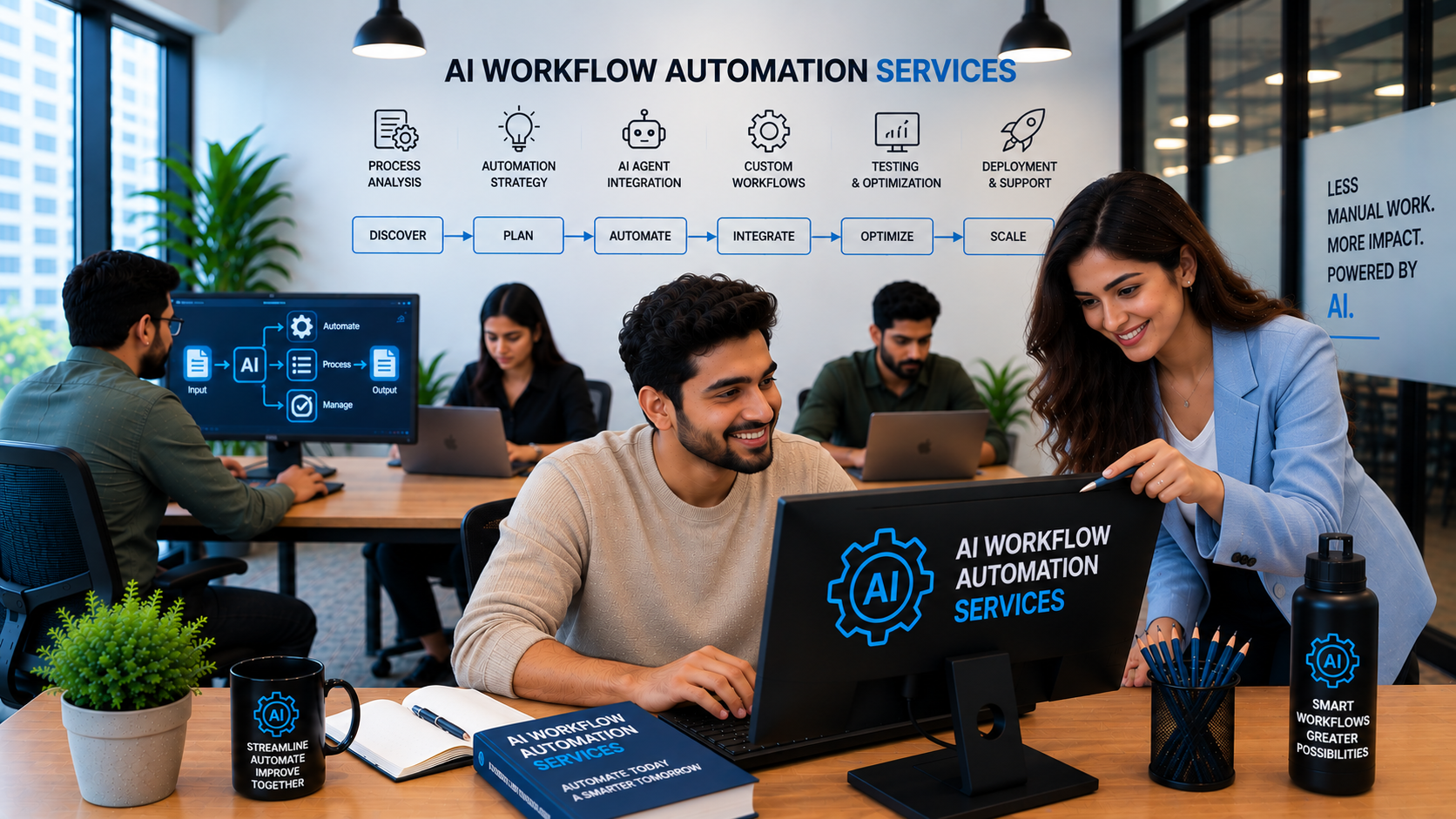
Move From Isolated AI Tasks to End-to-End Business Outcomes
Use AI where interpretation or reasoning adds value and deterministic automation where the process is known.
We look at the full process from trigger to completion, including manual handoffs, system boundaries, exceptions and approvals. AI is introduced only where interpretation or contextual reasoning improves the workflow; predictable steps remain governed by deterministic logic.
Three benefits.
Workflow-First
AI + Rules
Human-in-the-Loop
Business Workflows We Automate
Document & Data Workflows
Extract, classify, validate and route information.
Customer Operations
Assist support, onboarding and service processes.
Finance & Back Office
Automate document, approval and reconciliation workflows.
Sales & CRM
Enrich, route and coordinate sales operations.
IT & Service Operations
Classify requests, gather context and coordinate approved actions.
Industry-Specific Workflows
Digitize domain processes with rules, integrations and AI where useful.






Agentic Workflow Automation
Use agents where the workflow needs planning, not everywhere.
Agentic workflow automation is useful when part of a process cannot be expressed as a fixed sequence of rules. We combine agents with workflow state, approved tools, business validation and human checkpoints so dynamic reasoning remains inside a controlled operational process.
Context Interpretation
Multi-Step Planning
Tool / API Use
Business Rules
Human Approval
Exception Handling
Intelligent Workflow Capabilities
Capability
Triggers & Events
Supporting copy
Start workflows from schedules or events
Capability
Workflow Orchestration
Supporting copy
Coordinate states and steps
Capability
AI Classification
Supporting copy
Interpret unstructured inputs
Capability
Data Extraction
Supporting copy
Turn documents/messages into structured data
Capability
Business Rules
Supporting copy
Apply predictable logic
Capability
Agentic Reasoning
Supporting copy
Handle dynamic multi-step segments
Capability
API / Tool Calling
Supporting copy
Connect enterprise systems
Capability
Human Approvals
Supporting copy
Keep judgment in the process
Capability
Exception Handling
Supporting copy
Retry, route or escalate
Capability
Notifications
Supporting copy
Communicate status and actions
Capability
Audit Logs
Supporting copy
Track workflow execution
Capability
Monitoring & Analytics
Supporting copy
Measure completion and failures
How We Automate Business Workflows
Discover
Map the workflow, systems, people, exceptions and target outcome.
Prioritize
Identify high-value steps and decide where AI, rules or humans fit.
Design
Define orchestration, integrations, controls, data and approval points.
Build & Integrate
Implement workflow logic, AI components and system connections.
Test & Evaluate
Validate happy paths, exceptions, AI behavior and downstream actions.
Deploy & Optimize
Monitor completion, failures, approvals and business outcomes.
Power Your Operations with Intelligent Workflows
AI Workflow Automation Technology
5.0 REVIEWS
AI workflow automation usually spans more than one technology category because the workflow crosses models, APIs, business systems, queues, databases and user interfaces. We design the stack around reliable orchestration and integration rather than treating the LLM as the entire automation platform.
Models
AI Orchestration
Workflow Integration
Backend
Data
Cloud & Ops
Use the Right Mechanism for Each Step
Deterministic Rules
Known logic and predictable validation.
AI / LLM
Classification, extraction, summarization and interpretation.
AI Agent
Planning, contextual decisions and tool coordination.
Human
Sensitive decisions, exceptions and approvals.
Workflow Engine
State, routing, retries and completion.
Observability
Execution history, failures and performance.
Connect With the Systems Your Business Already Uses
CRM
Salesforce | HubSpot | custom CRM
ERP
SAP | Odoo | ERPNext | Dynamics 365
Documents
Email | file stores | document repositories
Communication
Email | SMS | WhatsApp | messaging APIs
Data
Databases | APIs | analytical systems
Identity
SSO | OAuth | RBAC
Engagement Model
Automate With Boundaries and Auditability
Operational automation should remain observable and controllable.
Permissions
Limit systems and actions available to automation.
Approval Gates
Require people where judgment is needed.
Data Boundaries
Apply user, tenant and source access.
Validation
Check AI outputs before downstream use.
Audit Trail
Track workflow steps and decisions.
Fallback & Escalation
Handle exceptions instead of silently failing.
Automation can create real downstream actions, so permissions, validation and approval boundaries need to be designed into the workflow. Execution history, retries and escalation paths help teams understand what happened and recover when a system or AI step cannot complete.
Why Choose Virtual Coders for AI Workflow Automation?

"Game-Changing Custom SaaS Solutions – Highly Recommended! Working with Virtual Coders to develop our custom SaaS platform was transformative. Their team grasped our unique needs and delivered a robust solution, greatly enhancing our operations. Their attention to detail and proactive communication made the process smooth and enjoyable. Highly recommended for Australian companies seeking to enhance their software solutions!"

Rick Giesel
Owner, ICT
Why Choose Virtual Coders for Workflow Automation?
✓Workflow discovery before technology selection.
✓AI, deterministic rules and humans used deliberately.
✓Deep API and enterprise-system integration.
✓Observable execution and exception handling.
✓Ability to build surrounding product interfaces and admin workflows.
Frequently Asked Questions



Which Workflow Should You Automate First?
AI workflow automation combines workflow logic with AI capabilities such as interpretation, extraction or reasoning to automate business processes across systems.
Traditional automation works well with predictable rules. AI can add value when inputs are unstructured or decisions require contextual interpretation. Many strong workflows combine both.
It is the use of automation, integrations and AI capabilities to coordinate a business process from input through decision, action and completion.
Agentic workflow automation uses AI agents for workflow segments that require planning, tool use or dynamic decisions, while retaining controls around permissions and approvals.
Good candidates often involve repetitive coordination, document/email interpretation, system handoffs, manual data entry, routing or approval bottlenecks.
Yes, when those systems expose suitable APIs, databases, webhooks or other supported integration methods.
Yes. Human approval can be inserted before sensitive or consequential actions.
Useful measures can include cycle time, manual touchpoints, exception rate, completion rate, approval time and cost per transaction where measurable.
SEND US A MESSAGE.

READY TO ACCELERATE YOUR TECH JOURNEY?
Partner with our expert engineers to transform your ideas into scalable, high-performance solutions tailored to your business needs.

OUR OFFICES
India
E-414 to 416, Ganesh Glory 11, Jagatpur Road, Nr. BSNL Office, off. S.G. Highway, Jagatpur, Ahmedabad, Gujarat - 382470
Australia
18, Giancarlo Crescent, Doolandella-4077, QLD, Australia
Canada
20 Meadowglen Pl, Toronto, ON M1H 2Y5