

Demand forecasting has quietly become one of the strongest competitive differentiators in modern business. Whether a company runs a retail chain, manages a manufacturing plant, operates an eCommerce platform, or distributes FMCG products, the ability to accurately predict future demand determines everything from inventory planning to procurement, staffing, cash flow, logistics planning, warehousing, and customer experience.

AI has changed forecasting dramatically. Instead of relying on spreadsheets, gut-feel decisions, or isolated historical patterns, businesses today want forecasting models that respond to real-time shifts in pricing, weather, supply chain abnormalities, market demand, and consumer behavior. This shift from traditional forecasting to intelligent prediction is possible only when businesses combine strong data pipelines, advanced ML models, and the right engineering ecosystem.

This guide takes you through the entire process of building an AI-driven demand forecasting software, aligning technical architecture (data engineering, ML model design, .NET backend architecture, deployment methodology) with business-friendly explanations so startup founders, SMB owners, and product managers can understand the approach clearly.

Why Is AI Demand Forecasting Important for Your Business?

Every business deals with uncertainty. But uncertainty in demand directly affects profits. When customer demand rises unexpectedly and your stock runs out, you lose sales. When demand drops and inventory stays on shelves, you generate carrying costs, wasted storage, and dead stock. For manufacturers, inaccurate demand means bottlenecks and delayed production. For distributors, it creates imbalances across regions. For retailers, it affects everything from pricing to promotions.

AI-based forecasting solves these challenges because it learns patterns that humans typically miss. While traditional forecasting looks at past data alone, AI forecasting includes dozens of external variables economic indicators, competitor pricing, seasonal behavior, demographics, market trends, real-time events, and even weather in some industries.

ML models continuously retrain themselves as new data arrives. This means your forecasts get better over time. For businesses working with a Machine Learning development company, predictive accuracy improves because the model learns specific patterns unique to your industry.

Benefits of Demand Planning Software for Small Businesses

Small and mid-sized businesses often operate with thin margins. A small surprise in customer demand can disrupt cash flow for weeks. AI-driven demand planning software becomes an extremely valuable business enabler. It helps SMBs make data-backed decisions instead of relying entirely on intuition.

Small businesses often struggle with manual spreadsheets, scattered data, and lack of forecasting expertise. A dedicated system solves these challenges by centralizing data, automating calculations, and offering easy-to-understand insights. 

When SMBs hire dedicated developers or engage a trusted Dot Net Development Company, they get a system tailored to their size, budget, and operational complexity. Unlike enterprise tools that are rigid and expensive, custom-built software ensures accuracy without overwhelming the team.

What Are the Factors That Impact Demand Forecasting?

Demand forecasting is influenced by an interplay of internal and external variables. Even businesses with stable sales cycles experience fluctuations due to unpredictable influences. The primary internal factors include historical sales, pricing patterns, store performance, promotional campaigns, product lifecycle stages, and distribution coverage. Meanwhile, external factors include competitor strategies, weather, macroeconomic conditions, seasonal periods like festivals, and supply fluctuations.

Modern demand forecasting software must incorporate both sets of variables. This is where Analytics and Business Intelligence become essential. BI systems help aggregate, transform, and analyze dozens of data points, ensuring that forecasts include the real context behind customer decisions. A good forecasting system doesn’t simply predict numbers it explains why the demand curve shifts.

How to Build a Demand Forecasting Software?

This is the core of the entire discussion. Building an AI-driven forecasting system involves a structured engineering approach. Below is the complete breakdown.

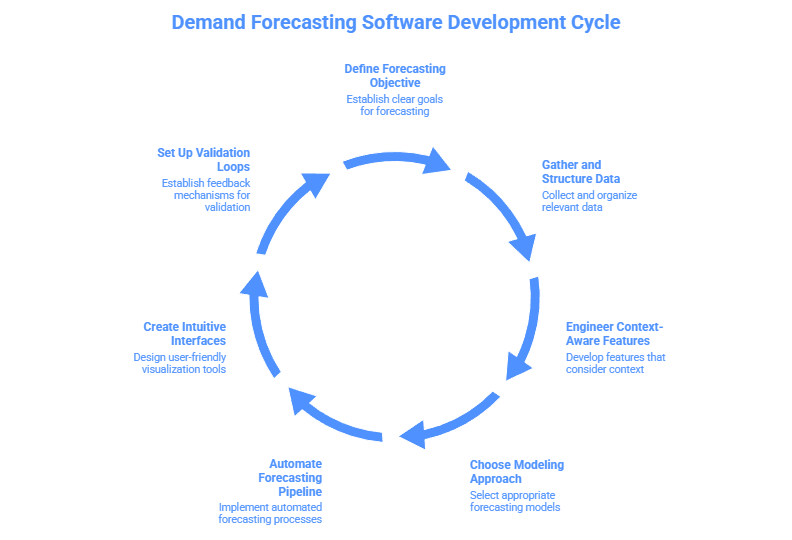
Demand Forecasting Software Cycle

1. Define the Forecasting Objective

Every forecasting solution begins with clarity of purpose. Businesses must clearly define whether they want daily, weekly, or monthly predictions. Some companies need SKU-level accuracy; others focus on category or regional forecasting.

Manufacturers may want a long-term forecast to plan production cycles. Retailers may need short-term demand to prevent stockouts. Logistic teams might want a region-wise forecast to avoid overloading warehouses.

Clear objectives make the architecture simpler. It also determines which ML model family is ideal time series, machine learning regression, or deep learning.

2. Gather and Structure the Right Data

Data is the backbone of every forecasting software. But data comes in many forms and from scattered sources. Sales reports, ERP data, CRM entries, marketing campaign logs, weather information, supplier schedules, and even Google Trends data may be relevant.

Before the ML pipeline begins, the first step is building a strong data engineering layer.

This includes:

• building data connectors that pull information from different systems

• cleaning and normalizing data

• handling missing values

• transforming raw inputs into structured sequences

Businesses often integrate automation using Business Process Automation workflows so that data ingestion runs without human intervention.

A Machine Learning development company ensures that the data pipeline is strong enough to handle both historical and live data with minimal latency.

3. Engineer Context-Aware Features

Feature engineering is the most important part of ML-based forecasting. The features determine what the model learns. Raw data in its original form rarely reveals accurate demand patterns. Engineers must derive time-based features (lag values, moving averages, seasonal factors), event-based features (holidays, discounts, festivals), price elasticity factors, and market conditions.

For example, an apparel retailer may see demand increase during festivals or cold weather. A food delivery business may see more weekend orders. A manufacturing plant may experience cyclical demand based on B2B orders. Each of these influences must become a feature in the dataset.

4. Choose the Right Modeling Approach

There are three major model families used in demand forecasting:

Classical Time Series Models

ARIMA, SARIMA, and Holt-Winters are ideal for businesses with stable, seasonal patterns.

Machine Learning Models

Random Forest, Gradient Boosting, and XGBoost are good for complex, multi-variable forecasting.

Deep Learning Models

LSTM, GRU, and Transformer-based architectures are best for long sequences and large datasets.

Deep learning models have become the industry standard for high-stakes forecasting because they can detect long-range dependencies and adapt to sudden pattern shifts.

A Machine Learning development company ensures proper model selection, hyperparameter tuning, and cross-validation based on accuracy metrics like RMSE, MAE, and MAPE.

5. Automate the Forecasting Pipeline

Manual forecasting doesn’t scale. Automation ensures that data extraction, cleaning, feature transformation, model retraining, prediction generation, and dashboard updates happen automatically.

For example, every night at midnight, the software may ingest new sales data, retrain the model if necessary, generate new predictions, and update dashboards accordingly.

Backend automation is often implemented using .NET Core, Python scripts, message queues, and cloud functions. Organizations working with a Dot Net Development Company or choosing to hire dedicated Dot Net developers gain the benefit of a scalable backend pipeline with secure APIs and cloud-friendly deployment.

6. Create Intuitive Visualization and Decision Interfaces

Forecast accuracy is valuable, but the insights must be easy for business teams to interpret. Good demand forecasting software includes intuitive dashboards that show trend curves, seasonality patterns, error reductions, confidence intervals, and demand predictions over future periods.

Using Analytics and Business Intelligence, businesses can integrate Power BI, Tableau, or custom .NET dashboards. Clear visual cues help store managers, supply teams, and decision-makers take action in real time, whether that means ordering inventory, adjusting pricing, or scheduling marketing.

7. Set Up Continuous Validation and Feedback Loops

Forecast accuracy improves when the system receives ongoing feedback. As new data flows in, the model must be retrained. Backtesting helps compare model predictions against actual sales. Validation metrics highlight whether the model is drifting or improving.

Modern AI forecasting systems operate as continuous learning environments. Not only does this improve performance, but it ensures the software remains adaptive even when market conditions change drastically.

6) How Long Does It Take to Develop an AI Demand Forecasting Module?

The timeline depends heavily on data availability, engineering complexity, dashboard needs, automation requirements, and the number of forecasting use-cases. A basic forecasting engine with limited models can be built in around four to six weeks.

A mid-level platform with BI dashboards, automation workflows, and multi-location forecasting usually takes eight to twelve weeks.

Highly advanced enterprise forecasting engines integrated with ERP systems, multi-warehouse inventory optimization, and deep learning models can take between three to six months.

Hiring a specialized engineering team or partnering with a strong Machine Learning development company reduces the timeline because they already have reusable model templates and data pipelines.

7) How Much Does It Cost to Develop a Demand Forecasting Solution?

A forecasting solution’s cost depends on data complexity, modeling depth, number of dashboards, cloud infrastructure, and integration requirements.

A small business solution ranges between $8,000 to $20,000, a mid-level forecasting system may cost $25,000 to $60,000, and a feature-rich enterprise implementation can go upwards of $70,000 to $150,000.

Working with a skilled Dot Net Development Company or choosing to hire dedicated developers lowers long-term cost because the architecture stays modular and maintainable.

8) What Are the Popular Approaches to Demand Forecasting?

Demand forecasting relies on several analytical approaches, each designed to handle different market conditions and data patterns. Traditional methods, such as time-series analysis, use historical data to detect seasonality and long-term trends. Causal forecasting models take this further by linking demand fluctuations to external factors such as pricing, promotions, and economic indicators. 

Demand forecasting with machine learning methods introduce non-linear pattern recognition, enabling forecasts that adapt to complex variables and changing behaviors. In recent years, deep learning architectures, especially LSTM and transformer-based models, have become the preferred approach for large datasets and industries that require high-accuracy, real-time forecasting. Businesses often adopt a hybrid model, combining multiple methods to maximize accuracy and resilience in unpredictable markets.

9) What Are the Different Types of Demand Planning Software Development?

Demand planning software varies significantly based on business needs, operational complexity, and the degree of automation required. Statistical forecasting systems provide straightforward predictions using historical data and are well-suited for stable, repetitive demand cycles. Collaborative demand planning platforms integrate human expertise from sales, supply chain, and inventory teams, blending qualitative insights with analytics. 

AI-driven planning software uses machine learning, real-time data ingestion, and automated optimization to deliver highly adaptive forecasts across multiple variables. Cloud-based demand planning platforms add scalability, faster deployment, and remote accessibility, making them ideal for growing enterprises or distributed teams seeking cost-efficient, modern forecasting tools.

10) Why Choose VirtualCoders to Build Your Demand Forecasting Software?

VirtualCoders brings together a structured blend of machine learning expertise, strong .NET engineering capabilities, and a proven track record in building high-performance enterprise systems. The team follows an end-to-end development model from data engineering and ML modeling to backend automation, UI dashboards, and cloud deployment ensuring that clients receive a complete, production-ready solution. 

Organizations looking to hire dedicated developers or collaborate with a seasoned Dot Net Development Company benefit from VirtualCoders’ ability to design scalable architecture, integrate secure APIs, and deliver custom forecasting engines tailored to their operational workflows. The result is a forecasting system that is accurate, reliable, flexible, and optimized for real business use.

Conclusion

Demand forecasting has evolved from simple spreadsheets to intelligent, AI-powered systems that learn continuously and adapt to market behavior. Building this type of software requires a combination of clean data pipelines, contextual ML models, automated workflows, and dashboards that turn predictions into actionable insights. 

As businesses navigate fluctuating markets, supply chain uncertainty, and rapidly changing consumer preferences, an advanced forecasting platform has become a strategic advantage. 

Whether you are a small business or an enterprise-level organization, investing in custom forecasting software helps improve accuracy, reduce operational waste and strengthen long-term planning. When developed with the right technology partners, demand forecasting is not just a tool; it becomes a core component of sustainable growth.

FAQs

1. What industries benefit the most from AI-driven demand forecasting?

Retail, manufacturing, FMCG, eCommerce, logistics, and healthcare sectors see the highest impact because they rely heavily on inventory and supply chain optimization.

2. How accurate can a machine learning forecasting model be?

Accuracy depends on data quality, model type, and external variable usage, but modern ML and deep learning models significantly outperform traditional forecasting in most environments.

3. Do I need a large dataset to get meaningful forecasts?

While more data improves accuracy, models can be trained effectively with smaller datasets when combined with external variables and proper feature engineering.

4. Can demand forecasting software integrate with my existing ERP or POS system?

Yes. Using robust .NET APIs and data connectors, forecasting systems can integrate smoothly with ERP, CRM, POS, warehouse, and eCommerce platforms.

5. How often should the AI model be retrained?

Most businesses retrain weekly or monthly, but highly dynamic industries may require continuous or daily retraining for maximum accuracy.

Want to reach us now?

Want to share more? Please send us an email to

Looking for a job? Send your resume to

Want to reach us now?

Want to share more? Please send us an email to

Looking for a job? Send your resume to

Please fill out the form below to help us better understand your software development needs.