

- Home
- Trending Technology
- Why Quantum Computing Matters ...
For decades, quantum computing lived mostly in research labs and academic papers. It was fascinating, theoretical, and largely disconnected from real-world software engineering. That perception is now changing.
In recent years, major technology companies like IBM, Google, Microsoft, and Amazon have made quantum computing accessible through cloud platforms. Startups are experimenting with quantum algorithms for optimization, cryptography, and scientific simulations. Governments are investing billions into quantum research. As a result, quantum computing is slowly moving from “future tech” to an emerging engineering consideration.
For software engineers and technology leaders, the question is no longer if quantum computing will matter but when and how it will intersect with modern software systems. While quantum computers will not replace classical systems anytime soon, they will influence how software is designed, secured, and optimized in the years ahead.
This article explores what quantum computing really means for software engineering, where the technology stands today, and how teams can prepare for a quantum-enabled future without falling for unrealistic expectations.
What Is Quantum Computing?
A Software Engineer’s Perspective
At its core, quantum computing introduces a new way of processing information. Traditional computers operate using bits that hold a value of either 0 or 1. Quantum computers use qubits, which can represent 0, 1, or both simultaneously through a concept called superposition.
Another key concept is entanglement, where qubits become linked in such a way that the state of one qubit directly influences another, even across distance. This allows quantum systems to process certain types of problems in parallel ways that classical computers simply cannot replicate.
From a software engineering perspective, the most important takeaway is this: quantum computing is not about faster CPUs or more memory. It is about solving specific classes of problems differently, especially those involving massive combinations, probabilities, and optimization challenges.
Quantum computing does not accelerate every task. For most everyday software workloads, web apps, mobile apps, APIs, and databases, classical systems remain vastly more efficient. Quantum advantage appears only in particular scenarios.
Why Quantum Computing Matters for Software Engineering?
Modern software engineering is increasingly constrained by computational limits. As systems become more complex, certain problems grow exponentially harder to solve.
Examples include:
- Optimizing logistics routes with thousands of variables
- Simulating molecular interactions in drug discovery
- Running complex financial risk models
- Training advanced AI systems with enormous state spaces
Current State of Quantum Computing (2025–2026)
Despite the excitement, quantum computing is still in its early stages. We are currently in what researchers call the NISQ era, Noisy Intermediate-Scale Quantum computing.
Today’s quantum machines:
- Have a limited number of qubits
- They are highly sensitive to environmental noise
- Produce probabilistic outputs rather than deterministic results
This makes them unsuitable for most production workloads. However, progress is steady. Cloud-based quantum platforms now allow developers to experiment with real quantum hardware and simulators. Enterprises are running proofs of concept in optimization, chemistry, and cryptography.
The key shift is accessibility. Quantum computing is no longer restricted to physicists. Software engineers can now interact with quantum systems using familiar programming tools and cloud interfaces.
Quantum Programming Languages and Frameworks
Quantum software development looks different from traditional coding, but it is becoming increasingly approachable.
Popular frameworks include:
- Qiskit (IBM) – Python-based, widely used in research and industry
- Cirq (Google) – Focused on near-term quantum devices
- Q# (Microsoft) – Integrated with classical programming ecosystems
Most quantum applications today follow a hybrid model. Classical code prepares data, sends specific tasks to a quantum processor, and then processes the results. This model aligns well with modern microservices and cloud architectures.
Rather than replacing existing stacks, quantum frameworks extend them.
How Quantum Computing Will Change Software Architecture?
Quantum computing will not lead to standalone “quantum apps.” Instead, it will reshape architecture patterns.
- Treat quantum processors as external services
- Use APIs to access quantum algorithms
- Integrate quantum tasks asynchronously
- Combine deterministic and probabilistic results
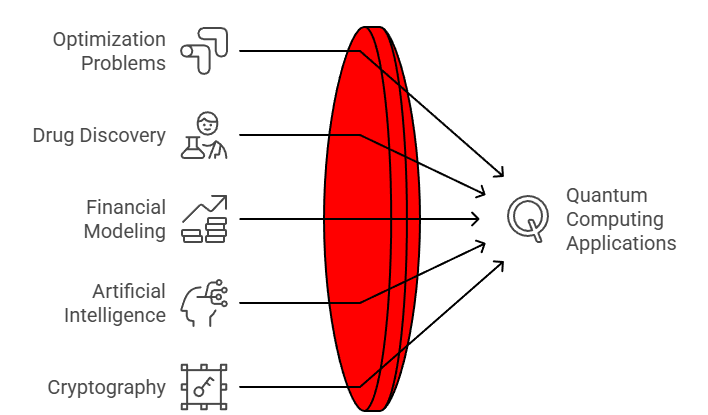
Key Software Engineering Use Cases for Quantum Computing
Quantum computing excels in specific domains:
> Optimization Problems
Logistics, supply chains, scheduling, and routing problems with enormous combinations benefit from quantum algorithms.
> Drug Discovery and Materials Science
Quantum simulation can model molecular interactions far more accurately than classical systems.
> Financial Modeling
Portfolio optimization, risk analysis, and fraud detection involve probability spaces well-suited to quantum techniques.
> Artificial Intelligence
While still experimental, quantum machine learning services may accelerate certain training and inference processes.
> Cryptography and Security
Quantum computing poses both threats and opportunities in encryption and secure communication.
These use cases will drive early adoption long before consumer software sees any impact.
Impact on the Software Development Lifecycle
Quantum computing challenges traditional assumptions in the SDLC.
- Requirements must define probabilistic accuracy rather than exact outputs
- Testing becomes statistical, focusing on confidence intervals
- Debugging shifts from deterministic tracing to outcome analysis
- Performance metrics focus on probability distributions
This requires a mindset shift for software teams. Engineers will need to embrace uncertainty as part of system behavior, much like modern AI systems today.
Quantum Computing and Cybersecurity
One of the most discussed impacts of quantum computing is its effect on encryption. Many current cryptographic algorithms could eventually be broken by sufficiently powerful quantum machines.
This has led to the development of post-quantum cryptography, designed to resist quantum attacks. Software engineers will need to update systems long before quantum threats become practical, especially in industries with long data retention requirements.
At the same time, quantum technology also enables stronger security models, including quantum-safe communication protocols.
Skills Software Engineers Will Need in the Quantum Era
Quantum computing does not turn every developer into a physicist. However, certain skills will become increasingly valuable:
- Strong algorithmic thinking
- Comfort with probabilistic systems
- Understanding of optimization problems
- Familiarity with hybrid architectures
Just as cloud literacy became essential over the last decade, quantum literacy will become a differentiator for senior engineers and architects.
Challenges Slowing Quantum Software Adoption
Despite its promise, quantum computing faces real obstacles:
- Hardware instability and error rates
- High operational costs
- Limited talent pool
- Immature tooling and standards
These challenges ensure that widespread adoption will be gradual rather than disruptive.
When Will Quantum Computing Become Practical?
One of the most common questions business leaders ask is whether quantum computing is something they should act on now or simply monitor. The honest answer lies somewhere in between.
Quantum computing will not suddenly replace traditional software stacks in the next couple of years. Instead, its adoption will follow a gradual curve, much like cloud computing and machine learning did in their early days. In the short term, quantum systems will mainly support research-heavy and computation-intensive domains such as financial modeling, scientific simulations, and demand forecasting software, where massive datasets and probability-based calculations are critical.
From a 2026 prediction from a tech perspective, we can expect more production-grade hybrid systems where classical software handles business logic while quantum engines assist with optimization tasks. These systems will still rely heavily on proven technologies like cloud platforms, microservices, and APIs.
For most enterprises, this means quantum readiness, not quantum dependency. Software teams that invest today in scalable architecture, clean code practices, and modular systems will be best positioned to integrate quantum capabilities when the technology matures.
How Businesses Should Prepare for the Quantum Era Today?
Preparing for quantum computing does not mean abandoning existing investments. In fact, the strongest foundation for quantum readiness is the modern software engineering discipline.
Organizations already investing in cloud app development services are ahead of the curve. Cloud-native systems make it easier to integrate external computation services, including quantum processors, without redesigning core infrastructure. Similarly, companies working with a reliable .NET development company benefit from enterprise-grade architecture, security, and scalability qualities that will remain essential in a quantum-enabled future.
Businesses should also start thinking about how advanced analytics and machine learning development services intersect with quantum computing. Many quantum use cases enhance predictive models, optimization engines, and forecasting systems rather than replacing them. This is especially relevant for industries relying on demand prediction, logistics planning, and financial simulations.
Rather than rushing into experimental investments, forward-thinking companies are running controlled pilots, partnering with experienced engineering teams, and building internal awareness around quantum-safe security and hybrid computation models.
The Role of IT Staff Augmentation in Quantum-Ready Engineering Teams
As quantum computing evolves, the demand for specialized talent will increase but hiring full-time quantum engineers will not be practical for most organizations. This is where IT staff augmentation becomes a strategic advantage.
Through staff augmentation, businesses can access niche expertise without disrupting their existing teams. Whether it’s adding architects familiar with quantum-aware system design or senior engineers who understand hybrid cloud and computation models, flexibility will be critical.
Companies that already hire dedicated .NET developers gain an additional advantage. The .NET ecosystem plays a growing role in cloud-based enterprise systems, quantum experimentation (via Q#), and scalable backend platforms. Augmented teams can gradually introduce quantum concepts while continuing to deliver stable, production-ready software.
In the coming years, staff augmentation will not just be about filling skill gaps it will be about future-proofing engineering teams with emerging technology awareness.
How Quantum Computing Aligns with Modern .NET and Cloud Development?
Quantum computing may sound futuristic, but its practical adoption will happen through familiar ecosystems. Platforms like .NET, Azure, and enterprise cloud services are already bridging the gap between classical and quantum computing.
A modern .NET development company does more than build applications it designs systems that scale, integrate, and evolve. This is where quantum readiness fits naturally. Hybrid architectures that combine traditional APIs, cloud services, and external computation engines align well with .NET-based backends.
Technologies such as Blazor development services and .NET MAUI development company offerings will continue to focus on frontend and cross-platform experiences, while backend services handle increasingly complex computational tasks. End users may never interact directly with quantum systems, but they will benefit from faster optimization, better predictions, and smarter applications behind the scenes.
From mobile app development services to enterprise platforms, the user experience will remain classical while the intelligence layer becomes more advanced.
Quantum Computing, Machine Learning, and Intelligent Forecasting
One of the most promising intersections of quantum computing lies in advanced analytics and machine learning. While classical machine learning models already power many modern applications, quantum-enhanced models may significantly improve performance in complex scenarios.
This is particularly relevant for demand forecasting software, where accuracy depends on analyzing massive datasets, market volatility, and unpredictable variables. Quantum-assisted algorithms could help organizations run simulations faster and evaluate more scenarios than traditional systems allow.
That said, machine learning development services will remain the backbone of intelligent software systems. Quantum computing will enhance ML workflows, not replace them. The future belongs to hybrid intelligence systems that combine classical AI, cloud scalability, and quantum optimization.
Strategic Role of Software Development Companies in the Quantum Future
As quantum computing transitions from theory to practice, software development companies will play a crucial role in responsible adoption. Not every business needs quantum solutions, but every business needs guidance.
A future-ready engineering partner understands when quantum computing adds value and when it does not. They help clients avoid unnecessary complexity while preparing systems for long-term innovation. Whether through IT staff augmentation, cloud modernization, or advanced analytics, the goal remains the same: build resilient, adaptable software.
Companies offering cloud app development services, enterprise-grade .NET solutions, and AI-driven platforms are best positioned to lead this transition. The focus will be on experimentation, education, and strategic readiness, not hype-driven implementations.
Final Thoughts
Quantum computing will not disrupt software engineering overnight. Instead, it will quietly reshape how complex problems are solved over the next decade. The most successful organizations will be those that prepare early, invest wisely, and partner with teams that understand both present realities and future possibilities.
From a 2026 tech standpoint, the winners will not be companies chasing trends, but those building scalable systems, nurturing skilled teams, and adopting emerging technologies at the right pace.
Quantum computing is not about replacing software engineers. It is about empowering them to solve problems that were previously out of reach.
Pratik Patel
Pratik Patel is the CEO of Virtual Coders and an experienced engineer passionate about technology and innovation. He shares valuable insights on our blog, covering topics from the latest tech trends to conversion optimization, to inspire and empower readers in the digital world.

Search
Recent Post
Why Quantum Computing Matters and How It
- 3 hours ago
- 11 min read
2026 Predictions in Tech: What to Expect
- 1 week ago
- 7 min read
How to Build a Demand Forecasting Software?
- 2 weeks ago
- 11 min read