

Quick Summary:
Artificial Intelligence is no longer a futuristic concept it is a competitive necessity. From predictive analytics and intelligent automation to Agentic AI systems capable of autonomous decision-making, organizations across industries are investing heavily in AI initiatives. However, despite growing budgets and executive enthusiasm, many AI projects fail to move beyond proof-of-concept stages.
At Virtual Coders, we’ve observed a consistent pattern: companies don’t struggle because AI doesn’t work they struggle because adoption is complex. Successful implementation requires strategic alignment, strong data foundations, scalable architecture, governance frameworks, and cross-functional expertise.
In this comprehensive guide, we break down the most common AI adoption challenges and provide actionable, enterprise-grade solutions to overcome them.
1. Poor Data Readiness and Fragmented Infrastructure
AI systems are fundamentally data-driven. Yet, one of the most common barriers to AI adoption is poor data readiness.
The Core Problem
Organizations often operate with:
- Siloed databases across departments
- Inconsistent data formats
- Incomplete historical datasets
- Lack of standardized data governance
- Limited real-time data pipelines
Without structured, reliable, and accessible data, even the most advanced algorithms fail to deliver meaningful outcomes. Many companies rush into AI model development without investing in data engineering and architecture a critical mistake.
Additionally, legacy systems create integration bottlenecks. When infrastructure is not cloud-native or API-ready, connecting AI solutions becomes costly and inefficient.
How to Solve It?
1. Establish a Centralized Data Strategy
Implement a unified data architecture, whether through a data lake, data warehouse, or hybrid architecture, that supports structured and unstructured data processing.
2. Build Robust ETL/ELT Pipelines
Automated data ingestion pipelines ensure clean, real-time data availability for AI models. This is especially critical in industries relying on Analytics and Business Intelliengece for decision-making.
3. Introduce Data Governance Frameworks
Define ownership, compliance policies, validation standards, and monitoring systems to maintain data integrity.
4. Modernize Infrastructure
Transition to cloud-native platforms and microservices architecture to enable scalability.
For organizations leveraging IOT Development Services, ensuring real-time sensor data ingestion and processing becomes even more critical. AI models that rely on IoT devices must process streaming data efficiently without latency or integrity issues.
Expert Insight
AI transformation begins with data engineering, not model training. Companies that invest in data maturity first achieve significantly higher ROI from AI initiatives.
2. Lack of Clear AI Strategy and Business Alignment
One of the most underestimated AI adoption challenges is the absence of strategic clarity.
The Core Problem
Organizations frequently:
- Launch AI projects without defined KPIs
- Pursue experimentation without scalability planning
- Invest in technology before validating business use cases
- Misalign AI investments with revenue or operational impact
This often results in “innovation theater” impressive demos with no measurable business value. AI should not be adopted because it is trending. It must address specific operational bottlenecks, enhance customer experience, or create revenue-generating opportunities.
How to Solve It?
1. Identify High-Impact Use Cases
Prioritize AI initiatives that directly support:
- Business Process Automation
- Predictive maintenance
- Intelligent customer support
- Risk analysis and fraud detection
- Revenue optimization
2. Define Measurable KPIs
Examples include:
- Reduction in operational costs
- Improvement in decision-making speed
- Increase in conversion rates
- Automation percentage achieved
3. Build a Phased AI Roadmap
Start with pilot projects, validate ROI, and scale gradually. This ensures technical feasibility and executive buy-in.
4. Align Technical Teams with Business Leaders
Cross-functional collaboration between domain experts and engineers ensures relevance and impact.
A strategic approach is particularly important when working with a specialized Machine Learning Development Company, as their technical capabilities must align with your industry-specific requirements.
Expert Insight
AI success depends more on strategic clarity than algorithm complexity. Organizations that treat AI as a business transformation initiative not just an IT project achieve sustainable competitive advantage.
3. Talent Gaps and Skill Shortages
AI implementation requires multidisciplinary expertise and this is where many companies encounter friction.
The Core Problem
There is a significant shortage of:
- Machine learning engineers
- Data scientists
- MLOps specialists
- AI architects
- Domain-specific AI strategists
Even organizations with strong development teams may lack production-level AI experience. Additionally, internal teams may struggle to transition from traditional global software development to AI-driven architectures.
For example, enterprises looking to integrate AI within enterprise-grade systems often need to Hire Dedicated dot net Developers who understand both AI integration and scalable backend systems.
How to Solve It?
1. Partner with an Experienced AI Team
Collaborating with a proven Machine Learning Development Company accelerates development while reducing risk.
2. Build Hybrid Teams
Combine internal domain experts with external AI specialists to ensure contextual accuracy.
3. Invest in Upskilling Programs
Train existing engineers in:
- MLOps best practices
- Model deployment pipelines
- AI governance standards
- Prompt engineering for generative AI
4. Expand Technical Capability Across Stacks
AI systems often require contributions from:
- Backend engineers
- Data engineers
- DevOps professionals
- Full Stack Developers
Well-rounded Full Stack Developers can bridge frontend visualization, backend APIs, and AI integration, ensuring seamless user experiences.
Expert Insight
AI adoption is as much about people as it is about technology. Talent strategy directly impacts scalability and long-term sustainability.
4. Infrastructure Scalability and MLOps Challenges
Developing a machine learning model is only the beginning. The real complexity begins when organizations attempt to deploy, scale, and maintain AI systems in production environments.
The Core Problem
Many AI projects remain stuck in proof-of-concept stages due to infrastructure limitations. Common issues include insufficient compute power, poor GPU allocation planning, lack of containerization, and absence of automated deployment pipelines. As AI models evolve, they require consistent retraining, monitoring, and performance evaluation.
Organizations experimenting with generative AI including open source AI models that generates professional 3d image outputs often underestimate hardware requirements and deployment costs. These models demand optimized GPU orchestration, distributed processing, and efficient inference pipelines.
Furthermore, without structured MLOps practices, companies struggle with:
- Version control of models
- Data drift monitoring
- Performance degradation detection
- Compliance logging
How to Solve It?
A robust infrastructure strategy should include:
- Implementation of CI/CD pipelines for AI models
- Containerization using Docker and Kubernetes
- Automated monitoring dashboards
- Hybrid cloud or multi-cloud optimization strategies
AI systems supporting Business Process Automation must integrate seamlessly with enterprise workflows and ERP platforms, requiring microservices-based architecture and secure APIs.
Scalable infrastructure combined with disciplined MLOps practices transforms AI from experimentation into sustainable business capability.
5. Security, Compliance and Ethical Concerns
As AI systems become more autonomous particularly with the emergence of Agentic AI governance and compliance risks increase significantly. Security and ethical oversight are no longer optional components of AI adoption; they are foundational requirements.
The Core Problem
AI systems process vast volumes of sensitive data, including personal information, financial records, and proprietary business intelligence. Without structured governance frameworks, organizations risk:
- Data privacy violations
- Regulatory penalties
- Biased or discriminatory outputs
- Intellectual property exposure
- Unauthorized model access
Regulations such as GDPR and emerging AI regulatory frameworks impose strict transparency and accountability standards. Companies deploying AI in industries like healthcare, finance, and manufacturing must prioritize compliance from the design phase.
Additionally, AI systems supporting Analytics and Business Intelligence require explainable outputs to ensure stakeholders trust automated decisions.
How to Solve It?
Organizations should adopt a multi-layered AI governance strategy:
- Implement explainable AI (XAI) techniques
- Conduct regular bias audits and validation testing
- Establish access control policies and encryption protocols
- Maintain detailed model documentation and audit trails
Security-first architecture is essential when integrating AI with IOT Development Services, where connected devices can introduce additional vulnerability layers.
Responsible AI strengthens brand credibility and ensures long-term operational sustainability.
6. Resistance to Organizational Change
Even with strong infrastructure and technical capabilities, AI adoption can fail due to organizational resistance. Cultural transformation is often the most underestimated challenge in AI initiatives.
The Core Problem
Employees may fear job displacement, loss of control, or reduced decision-making authority. In many enterprises, AI is perceived as a disruptive force rather than an enhancement tool. This resistance slows down adoption, reduces system usage, and ultimately impacts ROI.
When implementing large-scale Business Process Automation, employees accustomed to manual workflows may resist algorithm-driven systems. Similarly, data-driven recommendations from AI-powered Analytics and Business Intelliengece tools may face skepticism without proper context and education.
Lack of AI literacy among leadership teams can also result in unrealistic expectations or premature project abandonment.
How to Solve It?
Successful AI transformation requires structured change management:
- Conduct AI awareness workshops and executive briefings
- Communicate clearly how AI augments rather than replaces roles
- Start with pilot projects to demonstrate measurable impact
- Involve business stakeholders early in the development lifecycle
- Create transparent feedback loops for continuous improvement
Organizations that position AI as a collaborative tool rather than a replacement mechanism achieve higher adoption rates and sustainable transformation.
AI adoption is not purely technological; it is strategic, cultural, and operational evolution combined.
Conclusion
AI adoption is not a simple technology upgrade it is a strategic transformation initiative that impacts data architecture, infrastructure, talent strategy, governance, and organizational culture.
Companies that succeed typically:
- Build strong data foundations
- Align AI initiatives with measurable business goals
- Invest in MLOps and scalable architecture
- Prioritize security and ethical AI
- Develop skilled, cross-functional teams
At Virtual Coders, we combine AI engineering expertise, enterprise architecture knowledge, and strategic consulting to help organizations move from experimentation to production-grade AI systems.
Whether you need to integrate AI into existing enterprise platforms, leverage Analytics and Business Intelliengece, implement IOT Development Services, or scale your backend with teams that can Hire Dedicated dot net Developers and experienced Full Stack Developers, a structured approach makes all the difference.
AI is no longer optional. The question is not whether to adopt AI but how to adopt it strategically.
Organizations that overcome these challenges today will define the competitive landscape tomorrow.
FAQs
What are the most common challenges in AI adoption?
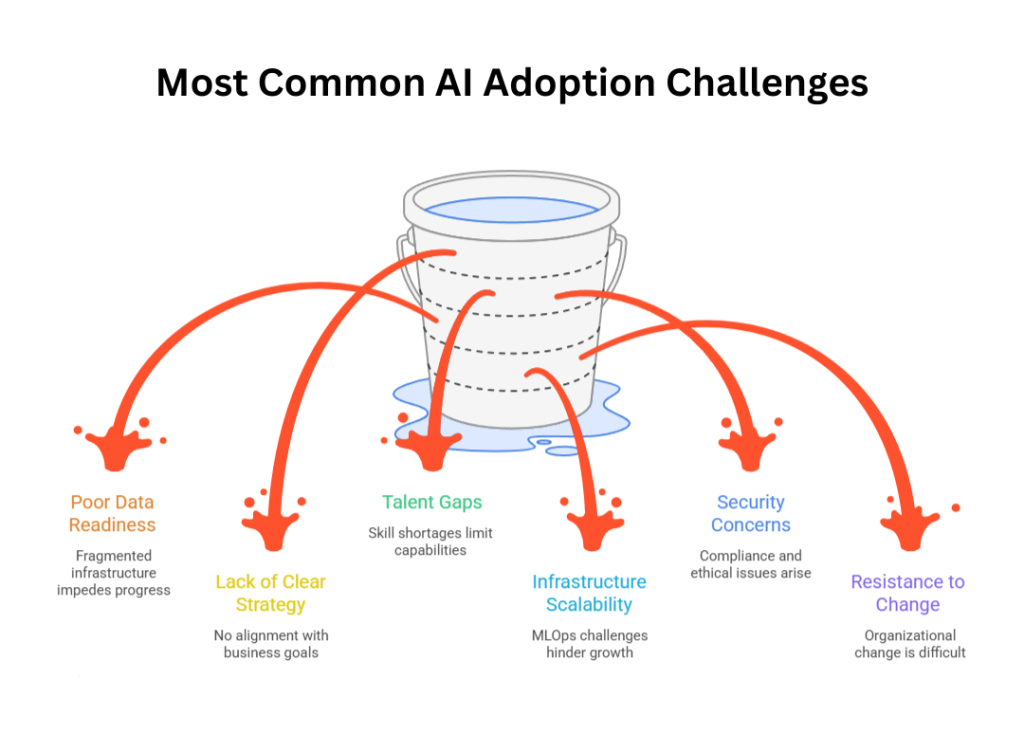
The most common AI adoption challenges include poor data readiness, lack of clear AI strategy, infrastructure scalability issues, talent shortages, compliance risks, and organizational resistance. Many businesses also struggle with aligning AI initiatives to measurable business outcomes such as revenue growth or operational efficiency. Successful AI implementation requires strong data governance, scalable MLOps practices, and cross-functional collaboration between technical and business teams.
Why do AI projects fail in enterprises?
AI projects often fail due to unclear business objectives, insufficient data quality, and lack of production-level deployment planning. Many organizations focus on experimentation instead of building scalable architecture. Without proper MLOps pipelines, governance frameworks, and integration with Business Process Automation systems, AI remains stuck at the proof-of-concept stage.
How can a Machine Learning Development Company help overcome AI adoption challenges?
A professional Machine Learning Development Company brings domain expertise, proven AI frameworks, and scalable deployment strategies. They help organizations design data pipelines, build production-ready models, implement MLOps best practices, and align AI solutions with measurable business KPIs. Partnering with experienced AI specialists significantly reduces implementation risk and accelerates time-to-market.
What role does data play in successful AI implementation?
Data is the foundation of AI systems. High-quality, structured, and accessible data ensures model accuracy and reliability. Organizations must implement centralized data architecture, automated ETL pipelines, and governance frameworks. AI solutions supporting Analytics and Business Intelliengece particularly depend on consistent, clean datasets for reliable business insights.
How does Agentic AI increase adoption complexity?
Agentic AI systems are capable of autonomous reasoning and decision-making, which increases governance and compliance complexity. These systems require strong monitoring mechanisms, explainability frameworks, and controlled execution environments. Organizations must implement strict AI governance policies to ensure transparency, security, and accountability.
Is infrastructure modernization necessary for AI adoption?
Yes. Legacy systems often lack the scalability required for AI workloads. AI models require containerized deployment, GPU optimization, and continuous monitoring. Businesses adopting AI-driven Business Process Automation must ensure their infrastructure supports microservices architecture and API-based integrations for seamless scaling.
How can companies address the AI talent shortage?
Organizations can bridge the talent gap by hiring experienced AI engineers, upskilling internal teams, and collaborating with technology partners. Many enterprises choose to Hire Dedicated dot net Developers and Full Stack Developers who can integrate AI models within enterprise-grade applications. A hybrid team approach ensures both technical depth and domain understanding.
What security risks are associated with AI implementation?
AI systems handle large volumes of sensitive data, making them vulnerable to privacy breaches and misuse. Risks include model bias, data leakage, unauthorized API access, and regulatory non-compliance. Implementing encryption, role-based access controls, and regular model audits helps mitigate these threats, especially in systems connected with IOT Development Services.
Can open source AI models that generate professional 3D images be used safely in enterprises?
Open source AI models that generates professional 3d image outputs can be powerful tools for design, simulation, and product visualization. However, organizations must carefully evaluate licensing, GPU requirements, data privacy implications, and deployment environments before enterprise use. Proper infrastructure and governance frameworks are essential to ensure secure implementation.
How long does it take to successfully adopt AI in an organization?
AI adoption timelines vary depending on data maturity, infrastructure readiness, and business complexity. A structured roadmap starting with pilot projects and scaling gradually typically spans several months to over a year. Organizations that align AI initiatives with measurable KPIs and long-term strategy achieve faster and more sustainable results.