

Quick Summary:
Enterprise software has always evolved in response to scale, complexity, and the need for predictability. As we move deeper into 2026, one thing has become increasingly clear across industries: .NET 10 is no longer just a development framework it is the backbone of modern enterprise software ecosystems.
From financial institutions and healthcare platforms to global SaaS products and government systems, organizations are making long-term architectural bets. They are not simply choosing tools; they are choosing stability, extensibility, security, and future readiness. .NET 10 sits confidently at the center of these decisions.
This shift is not accidental. It is the result of years of maturity, strategic alignment with enterprise needs, and the ability to adapt to trends like AI-driven applications, cloud-native architecture, automation, and distributed engineering models. In this article, we will explore why .NET 10 dominates enterprise software in 2026, how it supports next-gen application development, and why leadership teams trust it as a long-term platform.
The Enterprise Landscape in 2026: A Reality Check
Before diving into the technology itself, it’s important to understand the environment enterprises are operating in today.
Organizations are dealing with:
- Rapid digital transformation expectations
- Increasing demand for Next Gen-Apps
- AI is becoming a default, not a differentiator
- Distributed systems and global user bases
- Heightened security and compliance requirements
- Pressure to reduce operational costs without sacrificing quality
The 2026 prediction in apps is not about flashy features, it’s about resilience, interoperability, and speed of execution. Enterprises want platforms that can evolve without forcing rewrites every two years. This is where .NET 10 stands apart.
.NET 10: Built for Longevity, Not Trends
One of the strongest reasons .NET 10 has become the backbone of enterprise software is its long-term vision. Enterprises do not adopt frameworks lightly. They need guarantees around backward compatibility, performance improvements without disruption, and predictable upgrade paths.
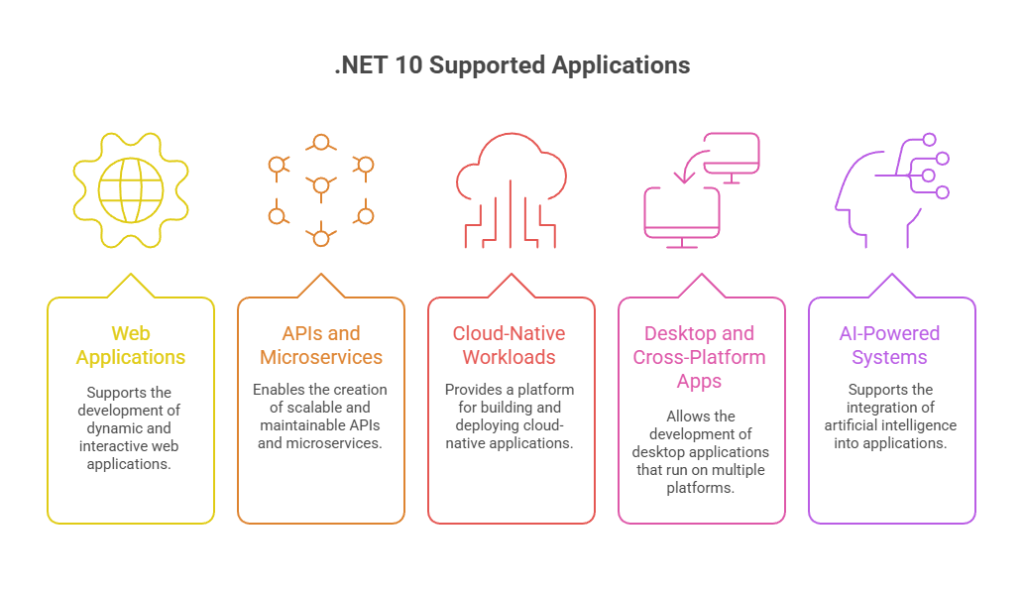
.NET 10 continues the evolution of a unified platform that supports:
- Web applications
- APIs and microservices
- Cloud-native workloads
- Desktop and cross-platform apps
- AI-powered systems
Rather than fragmenting the ecosystem, .NET 10 simplifies it. For CTOs and technology leaders, this means fewer architectural compromises and a cleaner technology stack.
Performance That Scales With Business Growth
Performance is no longer just a technical metric it’s a business requirement. Latency, downtime, and inefficiencies directly impact revenue and user trust.
.NET 10 delivers measurable improvements in:
- Application startup time
- Memory utilization
- High-throughput API handling
- Asynchronous processing
- Cloud and container performance
For enterprises offering Web App Development Services or managing high-traffic platforms, this performance consistency becomes a strategic advantage. Applications built today continue to perform efficiently as user bases and data volumes grow.
Cloud-Native by Design, Not by Adaptation
By 2026, cloud-native architecture is no longer be optional. Enterprises expect seamless deployment across hybrid and multi-cloud environments.
.NET 10 aligns naturally with cloud-native principles:
- First-class container support
- Smooth orchestration with Kubernetes
- Observability baked into application design
- Resilient microservices architecture
This makes it an ideal choice for Custom API Development Services, where scalability and reliability are non-negotiable. APIs built on .NET 10 handle internal systems, third-party integrations, and partner ecosystems with equal confidence.
AI Is No Longer Optional: Build AI Apps with Dot Net
AI has moved from experimentation to execution. Enterprises are now embedding intelligence directly into workflows, customer experiences, and decision-making systems.
.NET 10 plays a crucial role in this transformation by enabling teams to Build AI Apps with Dot Net without introducing unnecessary complexity. Whether it’s predictive analytics, recommendation engines, intelligent automation, or real-time insights, .NET provides the foundation.
Key advantages include:
- Seamless integration with AI and ML models
- Strong support for data-heavy operations
- Secure handling of sensitive business data
- Scalable inference and processing pipelines
For leadership teams, this means AI adoption without destabilizing existing systems.
Designing Data Foundations That Support Long-Term Growth
In 2026, enterprise systems are defined not by how quickly they launch, but by how well they scale and adapt over time. At the core of this longevity lies thoughtful data structuring. Strong Database Design and Architecture Services ensure that applications can handle growing data volumes, complex relationships, and evolving business requirements without performance degradation.
.NET 10 complements modern data architectures by enabling clean data access patterns, optimized query handling, and seamless integration with both relational and non-relational databases. Enterprises that invest early in solid database foundations avoid costly refactoring and operational bottlenecks later.
Well-architected data systems typically deliver:
- High performance even as data volume increases
- Clear separation between data access and business logic
- Improved data integrity and transactional reliability
- Flexibility to support analytics, AI, and reporting needs
- Easier maintenance and long-term scalability
For enterprise leaders, robust data architecture is not a technical detail it is a strategic asset that directly impacts decision-making, performance, and future innovation.
Automating Enterprise Operations With Precision and Control
Enterprise automation in 2026 is no longer about isolated scripts or task-level efficiency. It is about creating intelligent, reliable systems that streamline operations across departments while maintaining governance and visibility. Well-implemented Business process Automation Services enable organizations to reduce manual effort without introducing operational risk.
.NET 10 provides a stable foundation for automation by supporting workflow-driven architectures, event-based processing, and secure system integrations. This enables enterprises to automate complex processes, such as approvals, data synchronization, compliance checks, and reporting, without compromising transparency or control.
Effective enterprise automation focuses on:
- End-to-end workflow visibility and traceability
- Seamless integration with legacy and modern systems
- Role-based access and approval mechanisms
- Reliable execution under high-volume conditions
- Scalability as business operations grow
From a leadership perspective, automation built on .NET is not about speed alone. It is about consistency, accountability, and creating systems that empower teams rather than replacing them.
Cross-Platform Excellence With .NET MAUI
User experience has become a defining factor even in enterprise software. Internal tools are expected to be intuitive, fast, and accessible across devices.
This is where organizations increasingly look for a reliable Dot Net MAUI App Development Company. .NET MAUI allows enterprises to build cross-platform applications using a single codebase while maintaining native performance and design standards.
In 2026, MAUI-powered apps are driving:
- Internal productivity tools
- Field service applications
- Executive dashboards
- Customer-facing enterprise apps
For enterprises, this means faster delivery cycles and consistent experiences without multiplying development costs.
Security and Compliance
Security is no longer a checklist it’s a mindset. With increasing regulatory scrutiny and sophisticated threats, enterprises require frameworks that treat security as foundational.
.NET 10 delivers:
- Strong identity and access management integration
- Secure API design standards
- Built-in protection against common vulnerabilities
- Compliance-friendly architecture patterns
This is one of the reasons regulated industries continue to trust .NET for mission-critical systems.
Why Enterprises Prefer Specialization?
While the platform itself is powerful, execution matters. Enterprises increasingly choose to partner with a Custom Dot Net Development Company that understands both technology and business context.
Such partners bring:
- Architectural foresight
- Domain-specific experience
- Performance optimization expertise
- Long-term support models
.NET 10’s maturity makes it easier for specialized teams to deliver consistent results without having to reinvent foundational components.
Offshore Engineering Teams & the Rise of Distributed Delivery
The way enterprises build software in 2026 has fundamentally shifted from centralized teams to globally distributed delivery models. Offshore engineering teams are no longer viewed as tactical extensions but as long-term partners driving innovation and scalability. What makes this model successful today is not geography, but the strength of the underlying technology platform and .NET 10 provides that foundation.
With standardized development practices, strong tooling, and predictable architecture patterns, .NET 10 enables seamless collaboration across time zones. Enterprises can distribute workloads without fragmenting code quality or architectural ownership.
Key advantages of offshore delivery with .NET 10 include:
- Consistent coding standards across distributed teams
- Faster onboarding and smoother knowledge transfer
- Clear separation of concerns through modular architecture
- Easier governance, auditing, and code reviews
- Reduced dependency on individual developers
For leadership teams, this translates into controlled scaling, faster release cycles, and lower operational risk making offshore engineering a strategic advantage rather than a cost-driven decision.
Next Gen-Apps Demand a Mature Platform
Next Gen-Apps in 2026 are defined by adaptability rather than novelty. Enterprises are building platforms that must integrate AI, automation, real-time data processing, and multi-device experiences all while remaining stable under heavy usage. This level of complexity demands a mature, enterprise-ready framework like .NET 10.
Unlike experimental stacks, .NET 10 supports long-term evolution without forcing architectural rewrites. It allows organizations to layer innovation on top of a reliable core, ensuring that new capabilities do not compromise existing systems.
What enterprises expect from next-gen platforms in 2026:
- Built-in scalability for high user and data volumes
- Native support for AI-driven and data-intensive workloads
- Cloud-ready and API-first architecture
- Strong performance under real-world enterprise loads
- Flexibility to adapt to changing business models
.NET 10 enables organizations to build next-gen applications that are intelligent, resilient, and future-proof qualities enterprise leaders prioritize over short-lived trends.
Enterprise Web Application Engineering Beyond Interfaces and Frontends
Modern enterprise web applications are no longer limited to screens and user interactions. In 2026, they act as core business platforms handling workflows, integrations, compliance, analytics, and decision logic. Treating web development as a UI-only exercise creates long-term bottlenecks that enterprises cannot afford.
.NET 10 empowers teams to engineer web applications that go far beyond presentation layers. It enables clean separation between UI, business logic, APIs, and data layers, ensuring maintainability and scalability over time.
Enterprise-grade web platforms built on .NET 10 typically include:
- Secure role-based access and permissions
- Deep integration with internal and third-party systems
- API-driven communication across services
- High availability and performance at scale
- Strong alignment with business workflows
For enterprise leaders, this approach transforms web applications into strategic assets platforms that support growth, reduce operational friction, and evolve alongside the business.
Leadership Perspective: Why Decision-Makers Trust .NET 10
Technology decisions at the leadership level are rarely about trends; they are about risk, sustainability, and return on investment. In 2026, enterprise decision-makers continue to trust .NET 10 because it offers predictability without sacrificing innovation.
One of the strongest leadership advantages of .NET 10 is its ability to evolve without destabilizing existing systems. Enterprises can modernize incrementally, adopt AI and automation, and scale globally while maintaining control over performance and security.
Leadership-driven reasons for trusting .NET 10 include:
- Predictable upgrade and support lifecycle
- Proven performance in mission-critical systems
- Strong security and compliance alignment
- Wide talent availability and ecosystem maturity
- Lower long-term maintenance and operational risk
For CTOs and CIOs, .NET 10 represents a balanced choice modern enough to support innovation, yet stable enough to protect business continuity.
Why Modern Software Companies Are Aligning Their Delivery Models Around .NET?
Across industries, modern software organizations are standardizing their enterprise development around .NET 10. This shift is driven not by limitation, but by efficiency and strategic clarity. Standardization allows teams to focus on solving business problems instead of managing fragmented technology stacks.
By aligning delivery models around .NET, organizations reduce complexity across hiring, training, architecture, and maintenance. Teams become more interchangeable, best practices become reusable, and project execution becomes more predictable.
Benefits of standardizing enterprise delivery on .NET 10 include:
- Faster ramp-up for new projects and teams
- Consistent architectural and coding practices
- Easier long-term maintenance and upgrades
- Improved collaboration across departments
- Reduced technical debt over time
In 2026, leading software organizations understand that standardization enables scale. .NET 10 provides a common foundation that supports growth without slowing innovation.
2026 Prediction in Apps: Stability Will Beat Novelty
The enterprise application landscape in 2026 favors platforms that can endure. Organizations have learned that chasing novelty often leads to fragmented systems, rising costs, and operational instability. As a result, stability has emerged as a core competitive advantage.
.NET 10 supports this shift by enabling enterprises to innovate responsibly. It allows new features, AI capabilities, and integrations to be added incrementally without disrupting existing operations.
Why stability matters more than ever in 2026:
- Applications are expected to evolve for years, not months
- Downtime and failures directly impact revenue and trust
- Regulatory and security expectations continue to rise
- Enterprises need predictable performance at scale
- Long-term platforms reduce rework and hidden costs
For business and technology leaders alike, .NET 10 offers a platform that balances progress with reliability making it a cornerstone of sustainable enterprise software in 2026 and beyond.
Conclusion
In 2026, .NET 10 is not just powering applications it is supporting enterprise strategy. It enables AI adoption, supports automation, scales globally, and aligns with distributed teams. Most importantly, it does all of this without sacrificing stability.
For organizations looking to Hire dedicated dot net developers, partner with a Custom Dot Net Development Company, or invest in long-term digital platforms, .NET 10 stands as a proven, leadership-approved foundation.
The future of enterprise software is not about chasing trends. It’s about choosing platforms that quietly and reliably power growth. In that future, .NET 10 is not just relevant it is indispensable.