Build Enterprise Applications Around Real Business Workflows

Design and engineer secure business applications that connect users, workflows, data and enterprise systems, covering everything from new operational platforms to the modernization of established software.
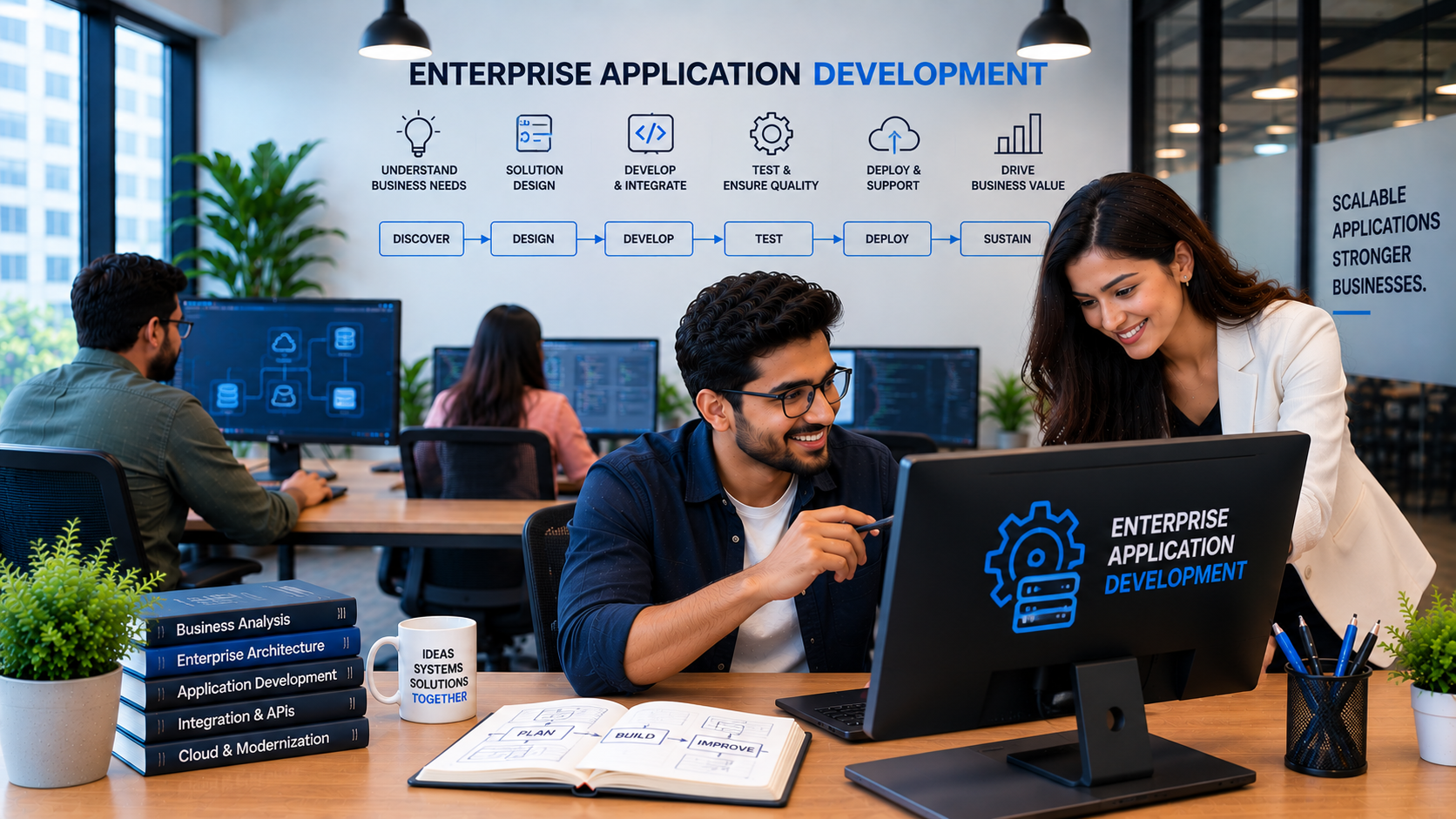
Turn Complex Business Processes Into Maintainable Software
Enterprise applications should simplify operations without hiding critical business rules.
We start with users, workflows, approvals, data and system boundaries before choosing the application architecture. This allows custom enterprise software to support real operational complexity while keeping permissions, integrations, auditability and future change manageable.
Three benefits.
Workflow-Centered Design
Integration Ready
Modernization Path
Enterprise Applications We Build
Business Operations Platforms
Custom systems for operational workflows, approvals and reporting.
Customer & Partner Portals
Role-based portals connected to enterprise services and data.
Field Applications
Web and mobile workflows for distributed teams and field operations.
Enterprise SaaS
Multi-tenant business platforms with configurable organizations and permissions.
Integration Applications
Workflow layers connecting multiple enterprise systems and APIs.
Modernized Legacy Systems
Re-engineered applications with modern UX, APIs and cloud deployment.






Enterprise Workflow & Integration Engineering
Connect the business process across the systems that already exist.
Enterprise applications rarely operate alone. We design workflow state, roles, APIs and integration boundaries together so users can complete a business process without manually reconciling information across disconnected systems. Where appropriate, automation and AI can assist specific steps without replacing deterministic controls.
Architecture
Integration
Data
Security
Delivery
Operations
Core Enterprise Application Capabilities
Capability
Role-Based Access
Supporting copy
Control application access according to user responsibilities.
Capability
Workflow State
Supporting copy
Model operational stages, transitions and business rules explicitly.
Capability
Approvals
Supporting copy
Route sensitive decisions through defined authorization workflows.
Capability
Audit Trails
Supporting copy
Record important actions and changes for operational visibility.
Capability
API Integration
Supporting copy
Connect enterprise applications with required services and platforms.
Capability
ERP/CRM Integration
Supporting copy
Exchange business data with established operational systems.
Capability
Notifications
Supporting copy
Deliver workflow alerts through appropriate communication channels.
Capability
Document Workflows
Supporting copy
Manage document creation, review, approval and retention.
Capability
Reporting
Supporting copy
Provide operational dashboards and decision-ready business information.
Capability
Multi-Tenant Patterns
Supporting copy
Separate customers, data and permissions within shared platforms.
Capability
Cloud Deployment
Supporting copy
Deploy enterprise workloads using maintainable cloud architecture.
Capability
AI Extensions
Supporting copy
Add governed AI capabilities to appropriate business workflows.
How We Deliver
Discover
Understand users, workflows, technical constraints and success criteria.
Architect
Define application boundaries, data, integrations, security and delivery approach.
Design
Translate workflows into usable interfaces, contracts and implementation scope.
Build
Develop in testable increments with code review and automated quality checks.
Validate
Test functionality, integrations, performance and security requirements.
Release & Evolve
Deploy, observe and improve the product as requirements change.
Ready to Move the Roadmap Forward?
Enterprise Application Development Technology Stack
5.0 REVIEWS
The stack should support maintainability, integration and the team's long-term operating model.
Frontend
Backend
Data
Integration
Identity
Cloud
Delivery
AI Extensions
Architecture That Supports the Next Stage
Product Fit
Align technical decisions with the product or team model.
Reusable Patterns
Standardize repeatable engineering work.
Integration
Preserve clean boundaries with external systems.
Quality
Build testing and review into delivery.
Observability
Make production behavior visible.
Evolution
Leave room for new features, scale and modernization.
Integrations & Ecosystem
Source Control
GitHub | GitLab | Azure DevOps
Cloud
AWS | Azure | Google Cloud
Identity
OAuth/OIDC | SSO | enterprise identity
Data
SQL | NoSQL | caches | object storage
Business Systems
ERP | CRM | finance | operational APIs
Delivery
CI/CD | containers | infrastructure automation
Engagement Model
Secure Enterprise Application Engineering
Build controls into architecture and delivery rather than adding them at the end.
Identity & Access
Apply role-aware access and least privilege.
Data Protection
Protect sensitive data in transit and at rest according to requirements.
Secrets
Keep credentials outside source code and unmanaged configuration.
Validation
Validate inputs, outputs and integration boundaries.
Auditability
Keep useful history for important actions and changes.
Recovery
Plan backup, rollback and incident paths according to business impact.
Security requirements vary by application and client context. We design identity, authorization, data protection, validation, secrets and operational controls around the actual system and avoid unsupported compliance claims.
Why Choose Virtual Coders for Enterprise Application Development?

"Game-Changing Custom SaaS Solutions – Highly Recommended! Working with Virtual Coders to develop our custom SaaS platform was transformative. Their team grasped our unique needs and delivered a robust solution, greatly enhancing our operations. Their attention to detail and proactive communication made the process smooth and enjoyable. Highly recommended for Australian companies seeking to enhance their software solutions!"

Rick Giesel
Owner, ICT
Why Choose Virtual Coders for Enterprise Application Development?
✓Cross-functional engineering capability across web, mobile, backend, cloud, QA, AI and data.
✓Experience connecting application development with APIs, integrations and production infrastructure.
✓Flexible engagement models for defined projects and ongoing engineering.
✓Modern technology stack without forcing unnecessary rewrites or complexity.
✓Transparent delivery and no unsupported performance, compliance or certification claims.
Frequently Asked Questions



Planning a New Enterprise Application or Modernization?
We begin by understanding the product or team objective, current stack, constraints, responsibilities and expected outcomes before finalizing scope or team composition.
Yes. The delivery model can integrate with existing repositories, architecture, backlog, tools and engineering standards.
Yes, depending on the engagement model. We recommend explicit change and knowledge-transfer processes so adjustments do not create delivery gaps.
Access should follow least privilege and the client's environment policies. Repositories, cloud accounts, credentials and production access are handled according to agreed responsibilities.
Yes. AWS, Azure and Google Cloud delivery can be included where relevant to the project.
Yes. Python, RAG, LLM integration, agents and data engineering can be incorporated when they solve a defined product or workflow need.
We use appropriate code review, automated testing, QA, CI/CD and acceptance criteria according to the project and risk.
Ongoing enhancement or engineering support can be structured through sprint-based, time-and-material or dedicated-team models.
SEND US A MESSAGE.

READY TO ACCELERATE YOUR TECH JOURNEY?
Partner with our expert engineers to transform your ideas into scalable, high-performance solutions tailored to your business needs.

OUR OFFICES
India
E-414 to 416, Ganesh Glory 11, Jagatpur Road, Nr. BSNL Office, off. S.G. Highway, Jagatpur, Ahmedabad, Gujarat - 382470
Australia
18, Giancarlo Crescent, Doolandella-4077, QLD, Australia
Canada
20 Meadowglen Pl, Toronto, ON M1H 2Y5