Build Kubernetes Platforms for Production Cloud-Native Workloads

Design, migrate and operate containerized applications on Kubernetes with repeatable deployment, observability, security and platform patterns across public cloud or hybrid environments.
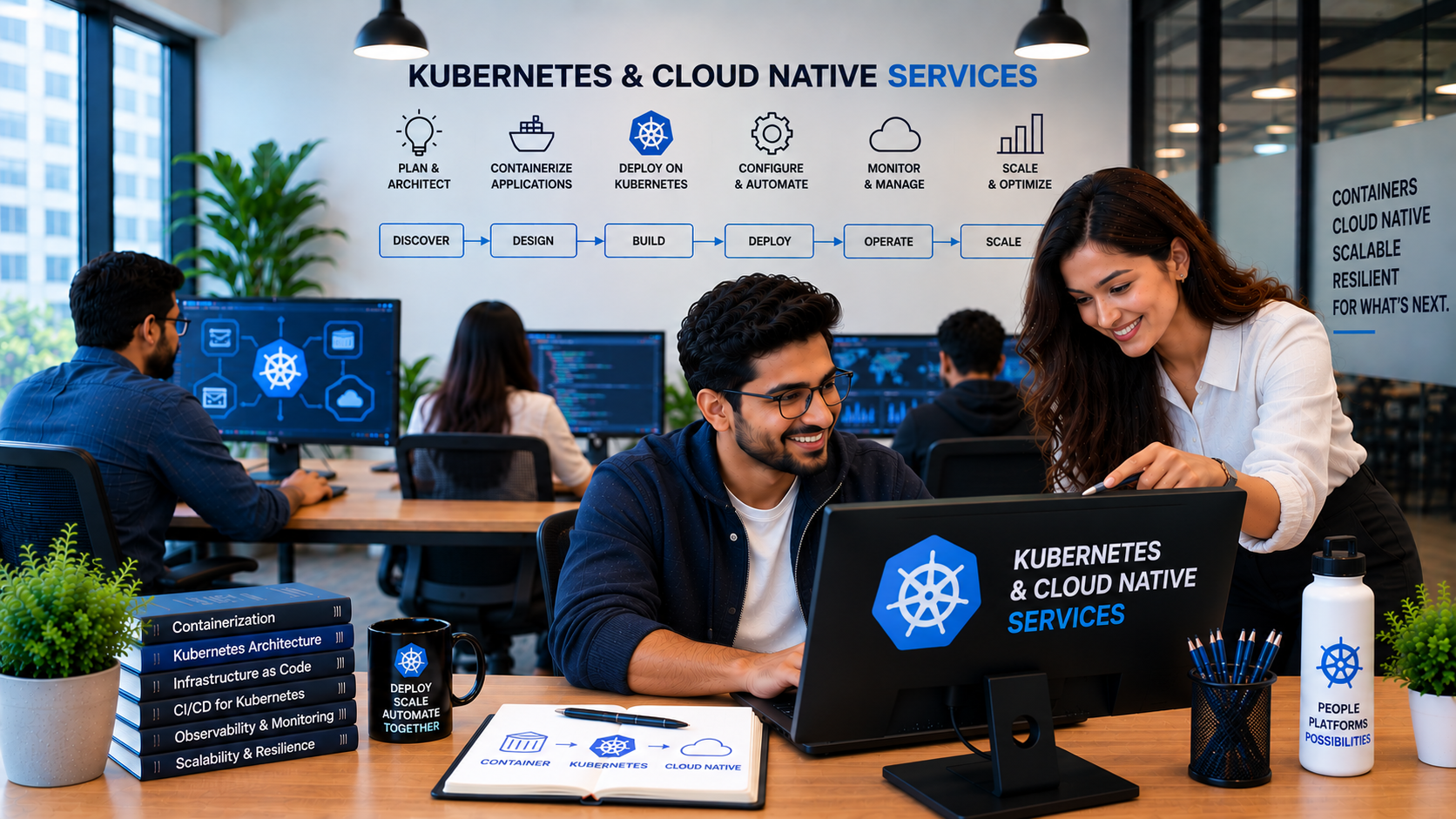
Move From Running Containers to Operating a Cloud-Native Platform
Kubernetes solves orchestration; production engineering solves everything around it.
We design Kubernetes together with application delivery, networking, configuration, secrets, observability, security and developer workflows. The goal is a platform that makes workloads easier to operate rather than a cluster that transfers infrastructure complexity to application teams.
Three benefits.
Production Architecture
Repeatable Delivery
Operational Visibility
What We Build
Kubernetes Application Platforms
Reusable environments for containerized services and applications.
Managed Kubernetes
EKS, AKS and GKE implementations aligned to cloud architecture.
Cloud-Native Applications
Microservices, APIs and event-driven workloads designed for container platforms.
GitOps Delivery
Git-driven application and configuration deployment patterns.
Observability Foundations
Logs, metrics, traces and operational dashboards.
AI Workload Foundations
Kubernetes infrastructure patterns for AI services and inference workloads where appropriate.






Managed Kubernetes Across AWS, Azure and Google Cloud
Use the cloud's managed control plane while keeping workload patterns portable where it matters.
EKS, AKS and GKE reduce parts of cluster management, but application teams still need consistent patterns for deployment, ingress, configuration, secrets, autoscaling, observability and security. We design those workload-facing layers around the selected cloud and engineering environment.
EKS
AKS
GKE
Helm
GitOps
Observability
Core Kubernetes & Cloud-Native Capabilities
Capability
Kubernetes Architecture
Supporting copy
Design cluster, workload and operational patterns around application requirements.
Capability
EKS
Supporting copy
Deploy and operate Kubernetes workloads using Amazon Elastic Kubernetes Service.
Capability
AKS
Supporting copy
Build managed Kubernetes environments on Microsoft Azure using AKS.
Capability
GKE
Supporting copy
Run scalable containerized applications through Google Kubernetes Engine.
Capability
Docker
Supporting copy
Containerize applications with repeatable runtime configurations and dependency boundaries.
Capability
Helm
Supporting copy
Package and manage Kubernetes application configurations across multiple environments.
Capability
GitOps
Supporting copy
Manage cluster and application configuration through declarative, version-controlled workflows.
Capability
Argo CD
Supporting copy
Automate and continuously reconcile Kubernetes deployments from approved Git repositories.
Capability
Autoscaling
Supporting copy
Scale workloads and cluster capacity according to demand and resource usage.
Capability
Ingress & Networking
Supporting copy
Configure secure application routing, service communication and external access.
Capability
Observability
Supporting copy
Capture workload metrics, logs and traces for monitoring and troubleshooting.
Capability
Policy & Security
Supporting copy
Apply identity, secrets, image and deployment controls across Kubernetes environments.
How We Deliver
Assess
Identify which workloads actually benefit from Kubernetes and map existing operational practices.
Design
Define cluster, tenancy, networking, storage, identity and delivery patterns.
Build
Implement Kubernetes foundation and reusable workload templates.
Migrate
Containerize and move applications in controlled stages.
Operationalize
Add observability, scaling, security, backup and incident procedures.
Enable Teams
Document golden paths and reduce day-to-day cluster complexity for developers.
Ready to Plan the Next Step?
Kubernetes & Cloud-Native Engineering Technology Stack
5.0 REVIEWS
Kubernetes
Containers
Packaging
GitOps
Infrastructure
Observability
Networking
Security
Cloud-Native Delivery With GitOps
Declarative Config
Keep desired application/platform state versioned.
Pull-Based Delivery
Use GitOps controllers where the operating model fits.
Environment Promotion
Promote reviewed configuration between environments.
Helm Packaging
Create reusable application deployment packages.
Drift Visibility
Detect differences between declared and runtime state.
Rollback
Use version history to support controlled recovery.
Integrations & Connected Systems
Cloud
AWS EKS | Azure AKS | Google GKE
Source Control
GitHub | GitLab | Azure DevOps
CI/CD
GitHub Actions | GitLab CI | Azure Pipelines | client tooling
Observability
OpenTelemetry ecosystem | cloud monitoring | metrics/logging tools
Security
Identity | secrets | scanning | policy tooling
Platform Engineering
Backstage / developer portals | self-service workflows where required
Engagement Model
Security & Governance
Design workload identity, secrets and policy as platform capabilities rather than afterthoughts.
Identity & Access
Least privilege and role-aware access.
Secrets
Keep credentials out of code and unmanaged configuration.
Data Protection
Protect sensitive data according to workload requirements.
Environment Boundaries
Separate development, staging and production appropriately.
Auditability
Keep useful deployment and operational history.
Recovery
Plan backup, rollback and incident paths according to business impact.
Kubernetes security spans cluster access, workload permissions, images, secrets, network exposure and deployment pipelines. We apply controls according to the threat model and cloud environment, while keeping approved developer workflows usable enough that teams do not bypass them.
Why Choose Virtual Coders for Kubernetes & Cloud-Native Engineering?

"Game-Changing Custom SaaS Solutions – Highly Recommended! Working with Virtual Coders to develop our custom SaaS platform was transformative. Their team grasped our unique needs and delivered a robust solution, greatly enhancing our operations. Their attention to detail and proactive communication made the process smooth and enjoyable. Highly recommended for Australian companies seeking to enhance their software solutions!"

Rick Giesel
Owner, ICT
Why Choose Virtual Coders for Kubernetes & Cloud-Native Engineering?
✓Full-stack application + platform engineering perspective.
✓Architecture choices connected to real product and operational requirements.
✓Cloud, DevOps, API, data and integration capability in one delivery team.
✓Incremental modernization rather than unnecessary rewrites.
✓No unsupported certification, compliance or performance claims.
Frequently Asked Questions



Planning a Kubernetes Migration or Platform?
They can include architecture, cluster/platform implementation, application containerization, migration, GitOps, observability, security and operational enablement.
Not always. Kubernetes is valuable when workload scale, orchestration, portability or platform standardization justify its operational complexity. Simpler managed runtimes may be better for some applications.
Yes. We can design managed Kubernetes environments across AWS, Azure and Google Cloud according to the client's cloud strategy.
Yes, after assessing application dependencies, state, networking, storage and operational readiness. Some applications may need refactoring before migration.
Yes. GitOps can be used to make Kubernetes configuration and deployment declarative and reviewable, using tools such as Argo CD where appropriate.
Yes. We can implement metrics, logs, traces, health checks and alerting using cloud-native and OpenTelemetry-compatible patterns.
Yes. CNCF research shows Kubernetes is increasingly used for production AI workloads, but AI infrastructure also introduces GPU, model-serving, data and observability requirements.
Security typically includes RBAC, workload identities, secrets, image and dependency controls, network exposure, policy and secure delivery pipelines according to the environment.
SEND US A MESSAGE.

READY TO ACCELERATE YOUR TECH JOURNEY?
Partner with our expert engineers to transform your ideas into scalable, high-performance solutions tailored to your business needs.

OUR OFFICES
India
E-414 to 416, Ganesh Glory 11, Jagatpur Road, Nr. BSNL Office, off. S.G. Highway, Jagatpur, Ahmedabad, Gujarat - 382470
Australia
18, Giancarlo Crescent, Doolandella-4077, QLD, Australia
Canada
20 Meadowglen Pl, Toronto, ON M1H 2Y5